Words and images

Philosophy on the streets

The stories we (don’t) tell — 2022-12-05

The stories we (don’t) tell

We all like a good story: happy or sad, of adventure, of loss, of perseverance…of experiences in and of life.

Storytelling is fundamental to us as humans. We tell stories, listen to them, seek them; sometimes we avoid them. Stories inform, persuade, challenge, entertain, strengthen and even weaken or break relationships. They punctuate our lives; they subsist in our being, in our environment. Without stories our lives loose much of their meaning.
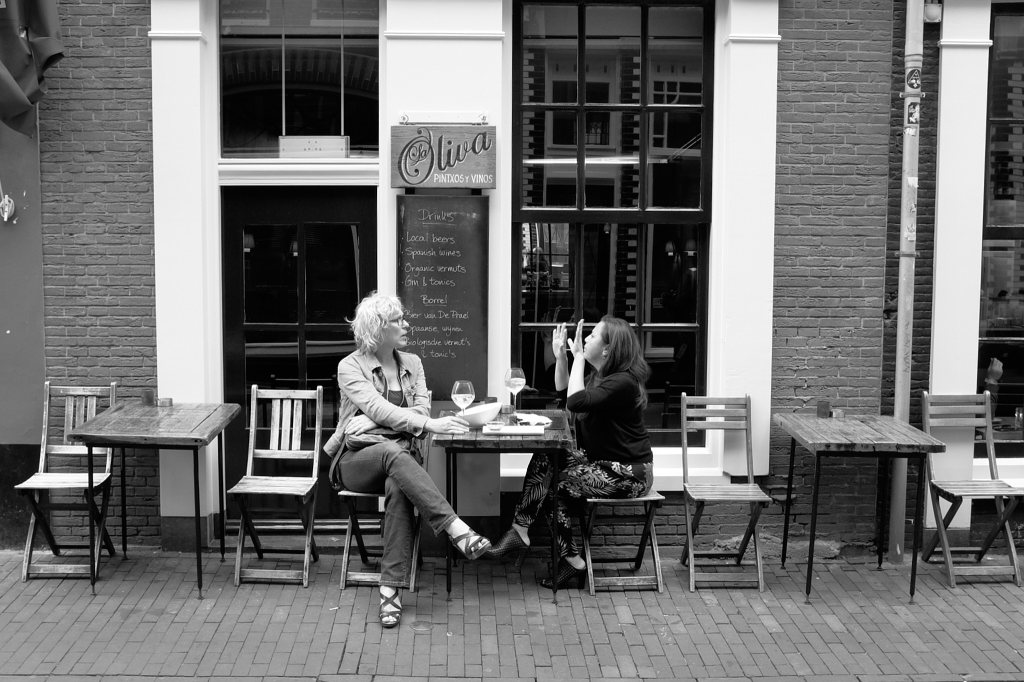
Two people in a cafe sharing a story with one person using expressive hand movements

Many stories are true, reflecting lived experience. But some are false, deliberately so. What makes one story true and another false is the basis of the story and its intent.

A true story is founded on, and relates, an event, action, process that actually happened. And while the telling may be embellished for storytelling purposes its intent is to share a personal experience. In the sharing may be found release, comfort, understanding, support, affinity, oneness, for both the storyteller and story taker.

On the other hand, a false—untrue—story, even though it may be based on some truth, has a different intent. Such a story may be designed to persuade, entertain, mislead, confirm biases or otherwise support a particular action or point of view.

When consuming a work of fiction—in any medium—we usually suspend our disbelief and enjoy the tale. We know it’s false after all. But sometimes, for some of us, our disbelief is replaced by belief, our biases reinforced, our beliefs confirmed. Some of us also consume truth as falseness, more evidence to support our beliefs and biases.

Fiction intended to change belief has a history as long as that for fiction intended to inform morals and behaviours. These later fictions are found in fables, parables, allegory, fairy stories; the bedtimes tales we tell our children both to instruct and entertain. To such fictions we respond (or expect the story taker to respond) with reverence, humour, belief, acceptance or understanding. The more profound the intended message the more we—the story taker—are challenged to understand, to grasp the insights offered through falsity.

So significant are stories to us that we laud successful stories and story tellers: Academy Awards, Pulitzer Prizes, Nobel Prizes, Booker Prizes, Walkley Awards. So many awards; so important to so many societies. But only for stories that exist in physical form. 

Verbal, oral stories are transient, not captured in a document, physical or digital. Yet such stories have been around for much longer than recorded stories. First Australians, for instance, have been telling stories for tens of thousands of years. Such stories persist because of their importance to those societies; they are part of the culture, integral along with behaviours and beliefs.

Then there are other stories, not spoken or recorded.

Some stories exist in our actions. They are implied. Open to reading and interpreting. There to be consumed if noticed. More personal than the truest ‘true’ story; their intent unclear, transient, confused. So much richer; so much more profound. So fleeting.

Two smiling women, one highlighting a banana she has placed at her waist.

Finally, there are stories resident in the physical world that will never be told. Objects abandoned, buildings derelict, weed strewn vacant lots. The detritus of our society. How did these come to be? What events lead to their current state? What laughs, tears, fights, loving occurred there or were occasioned by them? Was the coffee cup discarded before it was empty? Was the coffee enjoyed? Why was it discarded just there? While there is always a back story those stories will never be told because no-one is interested in them; they are the trivia of life, of our civilisation. Yet those stories tell us as much about ourselves as any other story. They simply have no story teller. And no story taker.
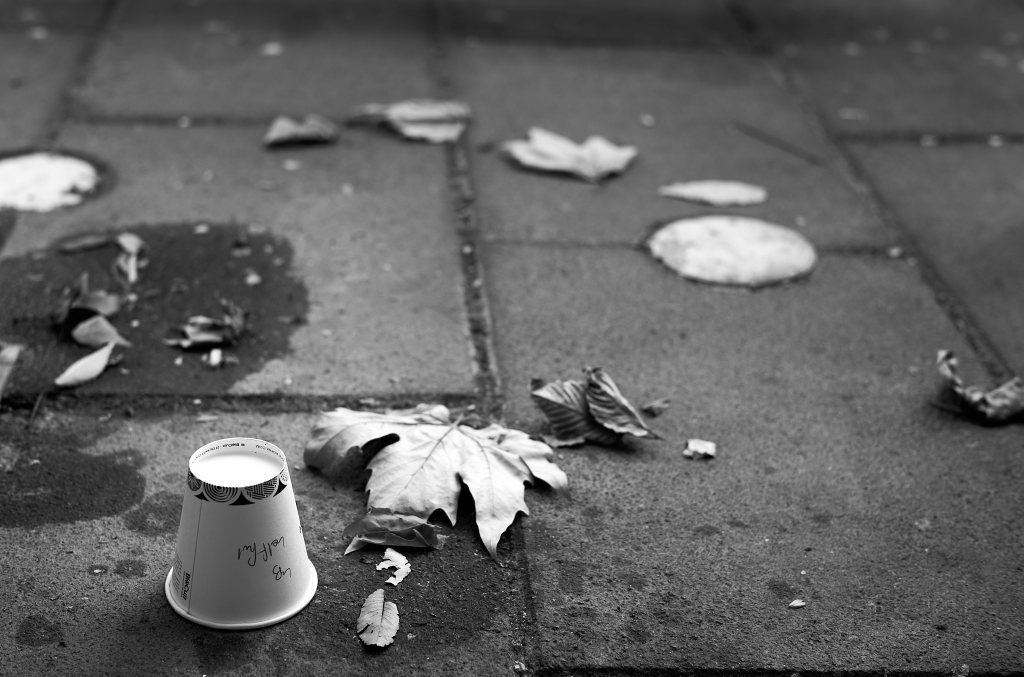
A discarded take away coffee cup on the ground surrounded by leaves and detritus of the city
Multi-coloured opinions — 2020-08-05

Multi-coloured opinions

Most of us see the world in wonderful colour: bright, subdued, brilliant or dull. Even those with colour blindness generally see in colour, though without the colour range of those lacking the affliction. Many animals, too, live in a colourful world. And dreams come in colour.

Without colour our world would be lacking. Colours allow us to differentiate otherwise identical objects. They influence our emotions, provide camouflage for birds and animals, and enliven our living rooms with huge coloured televisions. (Anyone remember black and white television?) The prospect of art without colour is most depressing and would certainly lessen its impact.

Overall, I guess we can say that we take colour for granted with all the nuances it offers us about the world we live in.

It’s a pity then that we don’t understand our opinions in terms of colour.

Too many people believe that opinions exist in a 2-bit colourful world. Issues are binary, black or white. There are no middle greys; no extenuating circumstances; something is either right or wrong. Sometimes it is; mostly it isn’t. It’s ideology at work: conservative/liberal, left/right, progressive/traditional.

Currently, we are amidst a largely 2-bit colour debate on the Caronavirus. It’s real; it’s fake news. It’s the flu; it’s much more than the flu. We should eradicate; eradication is not possible, we should eliminate. Masks should be worn; they infringe our freedom and legal rights. Or they work or don’t work. Hydroxychloroquine works or it doesn’t. We should be in lockdown/we need to open the economy.

So much black; so much white.

It’s largely the same with the climate crisis. Or is it climate debate? But at least this issue has some shades of grey: methods of remediation and minimisation, many of which make sense on their own merit. Or do they?

Eight-bit grey discussions allow some nuance, rather like limited colour vision. They also allow more scope for consideration of options, for changing views based on logic and evidence. Sometimes. 

Sixteen-bit grey opinions and beliegs represent an even more open climate for discussion, with many more nuances to consider and influence opinions and decisions.

Scientific debates tend to be cast in greys because they generally focus on a small part of our understanding of how the world functions. Even so, most scientists are prepared to change their views and theories when confronted with overwhelming evidence counter to their current understanding. Thomas Kuhn explored this process of changing scientific theory in his 1962 book The Structure of Scientific Revolutions. Unfortunately, such flexibility of thought is untypical of political debates and contentious issues except when it is politically expedient to do so. 

So much of current political debate, especially in two party (2-bit colour) states, is cast in terms of black/white or limited shades of grey, or both simultaneously. We need only look to America for evidence of this behaviour.

Open, honest and legitimate debate, however, requires our opinions and arguments to be in full colour, not grey, or black and white. Life is nothing but nuance; everything is a bit of this and a bit of that; connected to this or that. Nothing is pure: it’s all a shade of blue, or green, or orange or violet. Or of multiple shades of many colours, like rainbows.

Unless we explore opinions, beliefs and global challenges in a rich, nuanced conversation we limit our potential, our future, our experiences. We need coloured debates, not debates about colour (notwithstanding that this is an issue that needs to be addressed); not debates about right and wrong; not world views felt and expressed in black, white and grey.-

One might hope that this type of discussion may soon characterise our governmental institutions, especially our parliaments and political debates.

Our world is rich in colour. Why not our opinions.

Randomised democracy: the real people power — 2020-02-08

Randomised democracy: the real people power

So Australia Day—or Invasion Day as some call it—has come and done with nary a comment about the nature of our democracy. Sure there was the updated-for-2019 sports grants fiasco, but that really focussed on the conduct of the previous Minister for Sport and her gerrymandering grants to sporting organisations. Invasion Day protagonists concentrated on the dispossession of the first peoples and the nation’s failure to come to terms with its past. But everyone seemed to be happy with the nature of our democracy, even those who felt abused by the government’s abject failure—over decades—on climate change. And this despite research findings that many people, especially the young, feel that democracy has run its course and maybe, just maybe, we would all be better off under some form of dictatorship, especially a benign one.

So what is wrong with democracy?

Democracy is said to be about governing for the people—us—and the people—us—having a say who does the governing. This say is in the form of a vote for those who do the governing. How that vote is conducted, and from whom we may choose, is open to interpretation and various options are practiced. Of course, people being perverse, not all the practices are comparable despite their designation as democratic.

Generally, there are four components to democracy: style of democracy, selection of candidates, selection of voters and selection of our representatives. (I know that the following] taxonomy is a simplification but it serves my purpose.)

Democratic styles are really about choices in the mechanisms by which we are governed. Who holds the ultimate power: presidents or parliament? Is there one chamber of representatives or two? Are ministers/secretaries of state for xxx drawn from those elected or are they appointed from outside the representatives? Are simple majorities required to pass legislation or are there quotas to be met? Can anyone establish a political party or are all parties approved by some authority? Is inappropriate behaviour by representatives tolerated or not?

Selection processes for candidates vary. Some candidates are allowed from only a single party, others from any party. Some would be representatives are nominated or at least vetted by the prevailing government, others buy their way onto the ballot. Still others fight it out behind the closed doors of political parties while others fight it out in public, at considerable expense, and undergo a pre-election election to see who will be finally on the ballot paper.

Selection of voters is equally varied. Compulsory voting or optional voting? Centralised registration of voters or decentralised and often politicised registration of voters? Exclusion of certain people for appropriate or inappropriate reasons or just because they have the wrong skin colour, ethnic background?

When it comes to selecting our preferred candidate variety is again on show. Paper or digital technologies using online services or on-site voting machines? First past the post or preferential—but which preferential system?—or the greatest number of votes takes the seat? Direct election or election via caucuses? Single stage elections or multi-stage elections? Three year election cycles or four or five? Anyone over 18 can vote, or maybe 21 or even 16?

Perversity at its best for the core organising principle of our lives! And all this before we get to the behaviour and performance of those we elect. No wonder people are disillusioned by politics and have little faith in our politicians.

But there is one form of democracy that is absent from this taxonomy. In my view it is the ultimate form of democracy. In the view of those in power—if they even acknowledge it—I am sure it is seen as the least supportive of their ‘right’ to govern and exercise power, either directly as a politician or indirectly through the lobbying and other means of influencing government policy and practice.

I call this form of democracy randomised democracy. It works like this.

No elections needed; much money saved, because our representatives are selected at random from the citizens of a country/state/province/county. Each selected politician serves for, say, two years after which they resume their life of anonymity with a decent, but not excessive, pension. Allow for human perversity and have stratified random sampling to ensure that each ethic/cultural/religious group has a voice proportional to their number within the citizenry. Either way every person has an equal opportunity to direct how the country advances.

Significant roles like president, prime minister and ministers of state are also randomly allocated to those selected.

Parliament/congress/duma/whatever is supported by an informed bureaucracy charged with actually running the country under the oversight of the representatives.
No political parties with their political/religious/cultural/zealous/nationalist ideologies and policies also means there is no associated legislative program. Legislation is based on evidence provided by committees of experts selected on merit (notwithstanding the recent scepticism of the benefits of merit). These committees support the bureaucracy as well.

One important role for the bureaucracy and these expert committees is to come up with a consensus on the desired future of the country. Significant input to this consensus would come from the parliament; after all they are a representative sample of the citizenry, unlike now.

To my knowledge, this form of democracy has never been attempted and is unlikely to ever be implemented; it is much too radical and simple yet complex. But I believe it needs to included in any discussion of democratic systems and considered decisions taken about its applicability. After all, it probably wouldn’t produce outcomes worse than those many of us now experience.

And it might actually work, perversity notwithstanding.

Democracy_FUP5441
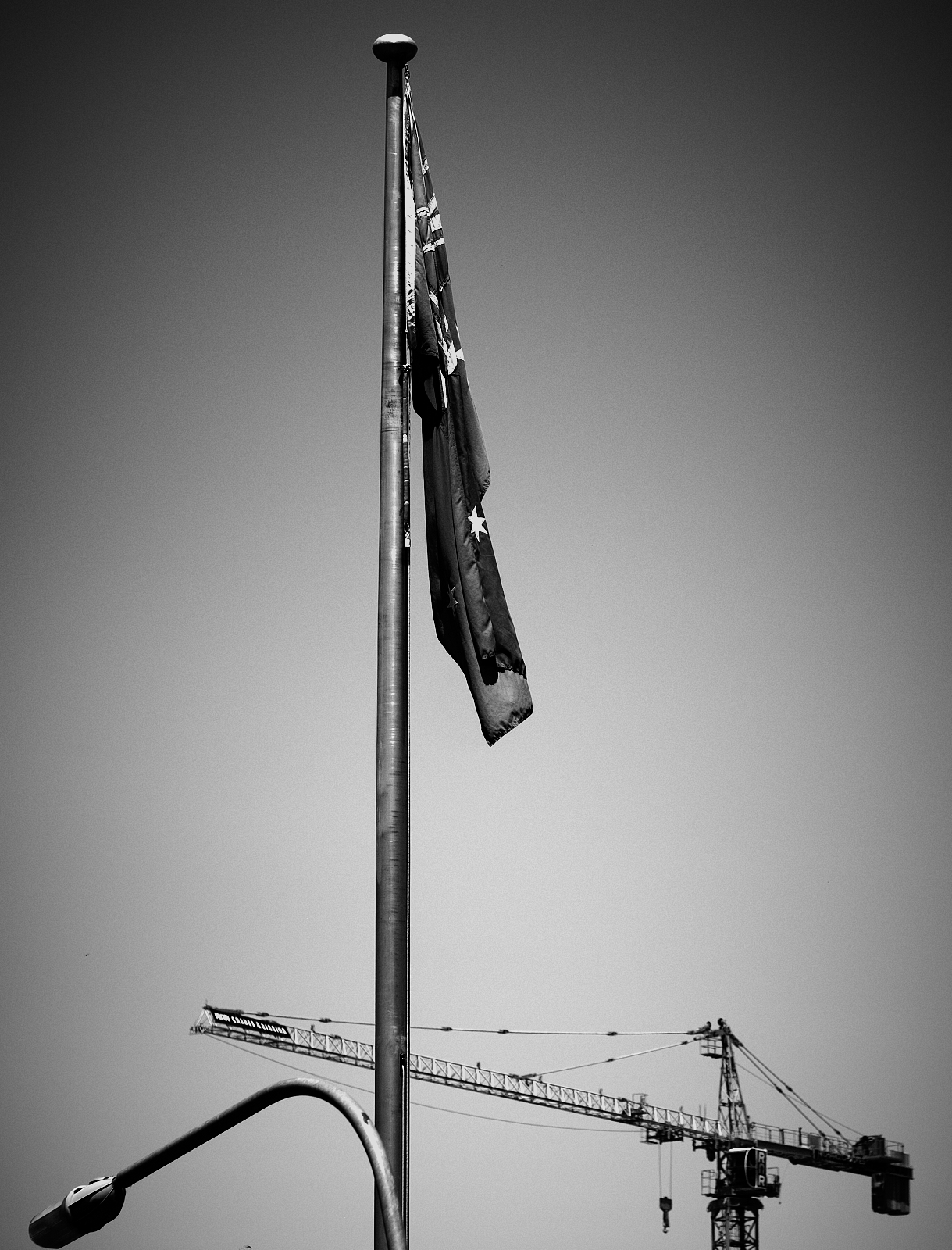
Australia…not flying the flag for anyone or anything, relying on the construction (and extraction) industry for its livelihood and with the lights out.

The land is burning — 2020-01-01

The land is burning

From my desk, through the window, I see the smoke: thick and blue. It hangs in the air, waiting to accost me should I or anyone venture out of doors or open windows. Not content with waiting in ambush, it also seeps through cracks infusing the air with its acrid aroma, tickling noses and throats.

Today’s smoke has hovered since last evening, as if it was resting after its long wind-propelled journey from the fires ravaging our land. It blocks the sun, the clouds. Birds refrain from aerobatics. Only the trees are restless in this polluted air, their small branches flustered by the recent light breeze in its half-heated endeavour to move on the smoke: rest time is over, it says, but the smoke ignores it.

Smoke has been part of our life for several weeks. Since we evacuated, twice, from our house sitting duties in the midst of the fire zone (we are now ), it has been a constant companion, the proverbial bad smell. Smoke itself, as bad as it is, is not the main concern; rather it is the fires generating the smoke. They have been burning for weeks, months in some cases. They are unstoppable. Only rain—lots of good, soaking rain—will stop them. But there is no rain forecast for several months. So the fires continue.

The bush burns. Animals burn. Towns and houses burn. And people burn. Our land is burning and there’s nothing I can do to stop it. Nothing anyone can do. We are at the mercy of nature. Always have been; always will be, however much we like to delude ourselves otherwise. Our efforts at ‘conquering’ nature are only temporary, forever reduced to feeble tinkering around the edges of life and nature while nature evolves new ways to retaliate, to resume control.

To speak of ‘conquering’ nature is rubbish. Our indigenous peoples learnt that 60 000 years ago. Instead, they reached an accord with nature, an accommodation: you look after us and we will look after you. Caring for country, they named the accord.

Bush fires_DSF7249

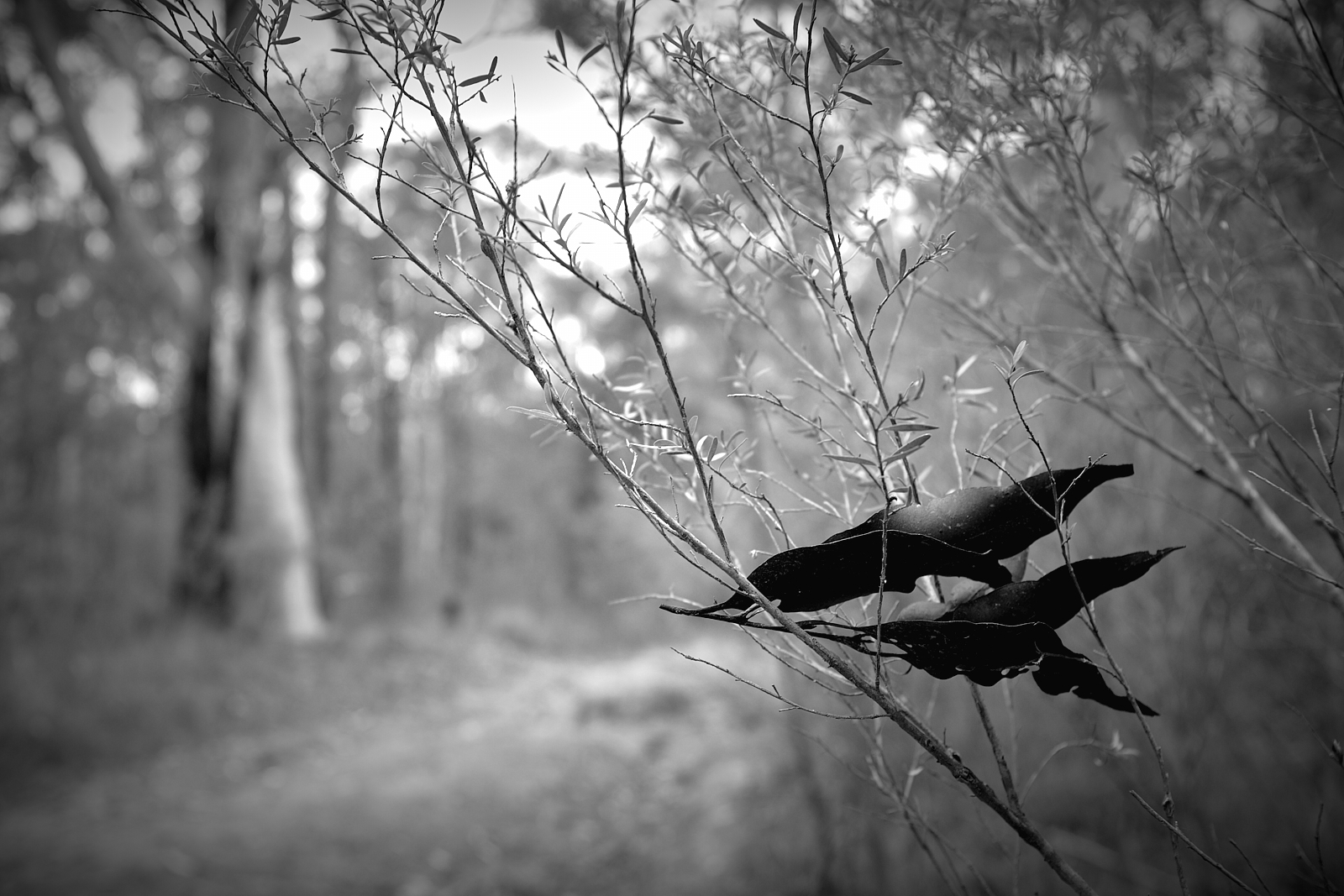
Singed but not burnt leaves

For 60 000 years the accord held. Until Europeans looked up this wondrous Terra Nullius with their conqueror eyes. Gradually, mine by mine, urban space by urban space, farm by farm, dry river by dry river, development by development, the land fell to the conquerors in their quest for economic gain, improved living standards and human development.

How can there be human development when the land is dry, empty and all aflame? When the trees and animals burn, when rivers fill with dead fish, when eon aged aquifers are sacrificed for bottled water no better than that flowing from our domestic taps; how can there by human development? When the air is hot and filled with fire smoke, how can there be human development?

We knew this would happen, the fires and drought. We were warned 30 years ago. We ignored those warnings. Our top fire fighters tried to warn our federal government months ago, but the government was not interested in listening, or even talking. So the fires, long forecast but never believed in, came. As did the smoke outside my window.

Are we—humans—so naive as to think that we are above the limits of our world? That in conquering the land we control it and its forces? Do we, the heirs of our conquering forebears, know the land and its needs and retributions better than those who have had 60 000 years of rapprochement with that same land? In our modern hubris and arrogance we have ignored the needs of our land and now the land burns and we suffer. There is no human development in these fires.

Bush fires_DSF7262

Singed leaves stuck in a shrub

Not content with fundamentally changing the natural world of our planet, we have now set our sights on discovering and exploring other planets to conquer. 

Why do we persist in seeking greener pastures? Is it because of our little acknowledged guilt in creating our brown, dry, degraded backyard? Do we, deep down, understand the travesty of our behaviour, of our breach of the long-ago created accord with nature? Do we seek cleansing absolution in a fanciful future in faraway places? 

Truely, we humans are a perverse species.

Bush fires_DSF7287

A beach of singed and burnt leaves