Words and images

Philosophy on the streets

On viewing historical objects — 2017-02-02

On viewing historical objects

The National Museum of Australia just closed its exhibition A history of the world in 100 objects with those 100 objects drawn from the very extensive collection of the British Museum. Objects ranged from stone tools to the prototype rig for Wi-Fi developed by the CSIRO (actually this was the 101st object). Naturally there was quite a bit of interest in the exhibition over the months it was open. And naturally that interest demonstrated itself in the queues awaiting admission.

People standing in a queue

But what was it that attracted our attention, that was worth the long, boring wait, and the quite reasonable admission price? The objects themselves; the stone, pottery, fabric, metals? That the objects were from the British Museum and so only available after a long, but relatively cheap, international flight? That the collection told the history of mankind, its technological progress from cave to radio wave connected portable electronic devices? Or its social and cultural evolution from rock art to modern art, represented respectively as a bison scratched on a piece of rock and a sketch of two male lovers in bed? Ultimately I guess each visitor had their own reasons for attending, their own need to extract meaning from the objects and the exhibition per se. From what I observed such needs were indeed met.

Setting aside these personal explorations for meaning, there is the larger question of why the objects were collected in the first place. Certainly the objects had an innate beauty or demonstrated great craftsmanship or had a practical use. Many required close inspection to appreciate what they were and the effort involved in their production.
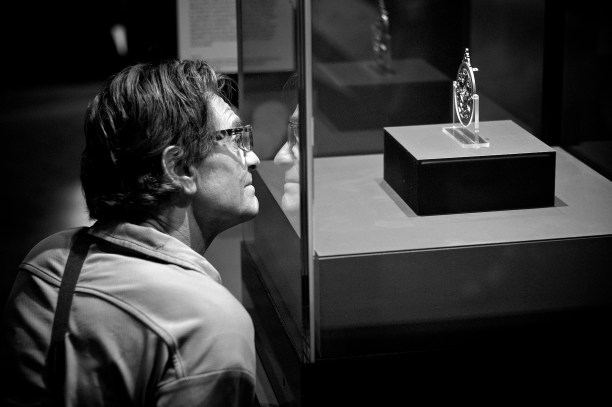
Close up of a man looking at an object in a protective case

Detailed inspection was supplemented by detailed notes accompanying each object, satisfying the need to know what the object was and, to some extent, its historical context. From the notes and inspection one could begin to understand how each object gained its place in the collection and its role in the past.

What I found missing from the exhibition, however, was connection. Each object existed and was displayed in isolation from all others, connected only by way of their era-based arrangement. Yet no gestalt was provided to integrate the disparate objects, to make patterns, to form themes, to provide a framework for making historical sense and relating the past to the present and, indeed, to the future.

Hence, making sense of the collection as a collection—drawing links, comparing technologies and cultures, developing a deep understanding of the progress of humankind—was left to us as viewers.

Thus, delving into our own history our own experiences we made sense—more or less—of all that we saw. Did this then make us participants in the exhibition? Were we the ultimate subject of the display? Were we, the viewers, also the omnipresent creator of each object? If so, my participation was akin to a cameo role in a play or movie. So overwhelming was the scope of this sense making—so diffuse and different were the objects—that my attempts at sense making—and meaning making—proved inadequate.

This is not to say that the exhibition was without merit. Far from it. To see in the one room objects representing 20 000 years of human endeavour is to highlight the continuity, creativity and persistence of humanity. It is to understand that we—our technologies, our cultures, our societies, each of us as an individual—are but part of a continuing story, the evolution of humanity. It is also to highlight just how fleeting we are, as individuals as technologies, as cultures and as societies. Finally, it is to acknowledge that in all we do each day history, personal and human, stands behind us as a shadow, watching us yet enticing us towards a future that will be as transient as our past. We, in turn, are often unaware of that shadow or ignore it and its lessons.
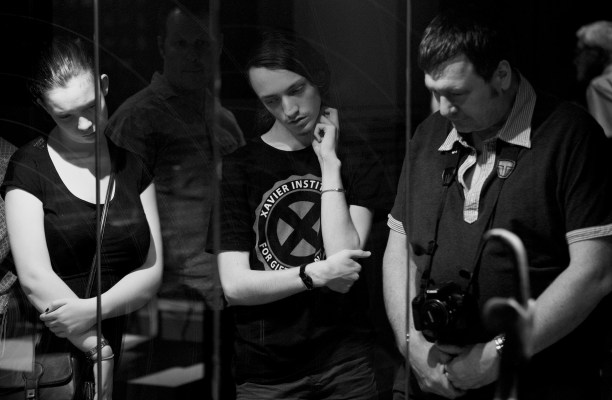
Three people looking down with another in the background looking over their shoulder

Without our history we are without context. Without an appreciation of our past, our future is without a foundation. One hundred objects do not a history make, but they do stand in place of all those and all that which has preceded us and upon whose existence we have created our own rich present and set the scene for our unknown future.

Here’s to made objects and their shadows.
The empty night — 2016-12-22

The empty night

Empty city streets have always fascinated me, filled me with an emotion I cannot name.

My first exposure to this phenomenon—and when I first recognised it—was in London in the mid-1970s. Walking through the back streets towards Baker Street (to check out Sherlock’s abode, of course) generated this feeling of emptiness, of spaciousness, of loneliness, of the lack of life, human or otherwise.

A decade later, the same emotions arose, but in a different set of back streets.

Since then the feelings have come and gone as I explored and wondered the back streets of various cities around the world.

Always that feeling of emptiness and loneliness; of something alien.

Back streets at night are even more poignant and emotive.

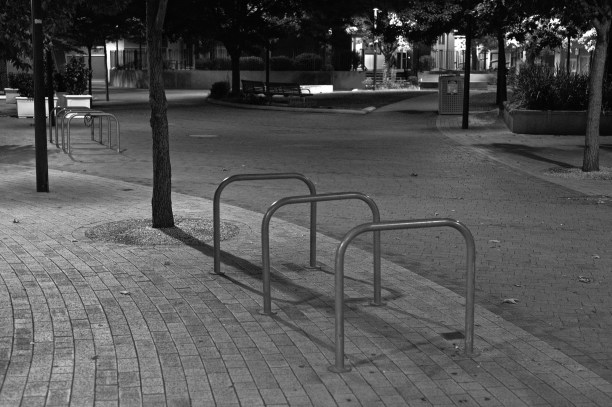
Empty street scene at night with bike racks in the foreground

There, diffused in artificial light, buried in shadows, fading into the black background, is the architecture of the absent working world: vacant bike racks, deserted streets, empty footpaths, silent coffee shops, soundless offices and customerless shops.

Counterpoised against this architecture of construction is the architecture of nature: planted trees, beds of wilted flowers, dried lawns. The constructed enhanced—and humanised— by nature. But there is nothing natural about this artificial entwining of the built and the grown. What is constructed is an overwhelming tension between the vacant now, the immoderate past and the dormant future.

Sometimes though, in this shadowed world of greys and blacks, are the signs and symbols of expressed life and half finished work.

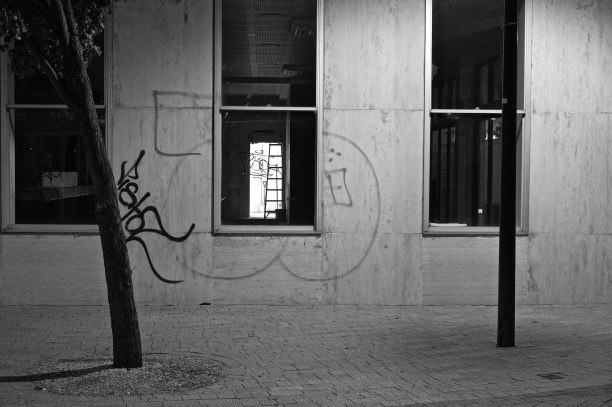
Night scene of wall with graffite

A workman’s ladder and shovel in an empty building. Graffiti. Sometimes a discarded bottle or can. Detritus of life; past life in progress; future life suspended in the unfinished past. Entropy facilitating time and life.

Yet these empty, dark, silent streets are not always so alien, so half-filled with life. Often they are also the backdrop to tragedy and comedy, to anguish and joy, to forgiveness and error, to compassion and hate. Private—or not so private—emotions shared in a public space. Hidden, but apparent to those who see.

Couple hugging in a street at night

Backdrop or not, empty, shadowed, back streets reflect the emptiness and shadowed cosmos in which we dwell. Perhaps, for me, they also reflect the inevitable emptiness and shadowless void of death which awaits me as it does all of us. Maybe this is why I am ambivalent towards such scenes: life hidden in the shadows of death.

Life is perverse.

Shadows — 2016-12-05

Shadows

Shadows, those volumes of darkness beloved of visual creatives—painters, photographers, movie directors—enfold us in their invisibility. We see or do not see them as our mood varies, as our view dances from point to point creating a gestalt, even a story, of our reality.

We see the world writ large in shadows, often imposing, often subtle. For their part, shadows protect their charges in anonymity allowing our imagination to construct what is not, or is only partially, visible. Yet many objects under the influence of shadows use that protective cloak to display their own innate beauty, to create their own contrasting gestalt, their own story.

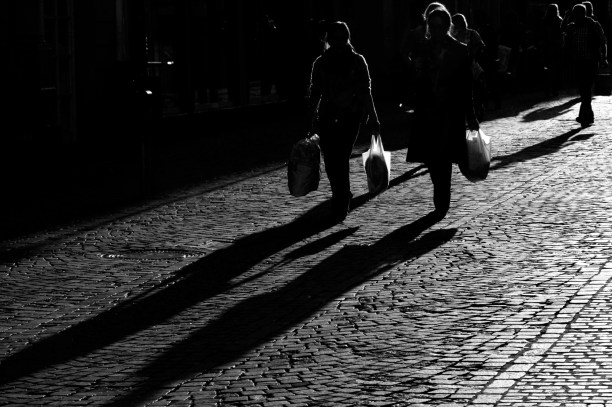
Backlit people walking down a cobblestone street

While most shadows are arbitrary, a product of the the interaction of the vagaries of nature—wind, sun, season, time of day—and object, others are deliberate creations. Amusements for our humour, our imagination, our sense of fun. We create, destroy, manipulate, intercept light just as we create, destroy, manipulate and intercept the physical and biological world so dependent on that light and its resultant shadows. Like us and their sibling natural shadows, created shadows are ephemeral. What remains after their passing is just a memory or an image of absence.

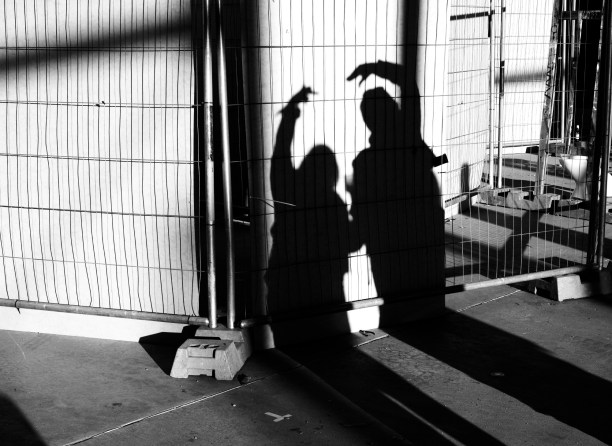
Shadows of two women creating an arc on a wall

By means deliberate or accidental, shadows can also reveal, through their absence, that which is there. Such non-shadows are as pervasive and invisible as the shadows with which they co-exist. And when they do reveal themsleves we forget the shadows and their old gestalt. Instead, we create a new gestalt, a new story, centred on the non-shadow. If we are lucky, or so inclined in our storytelling, that new story is richer, more fulsome and more profound than the old one told by the shadows alone.

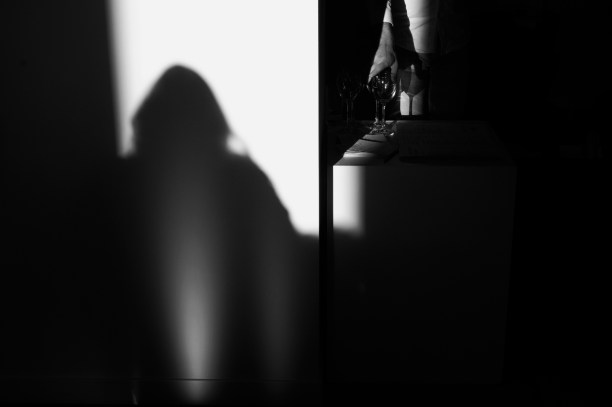
A shadowed hand reaching for a glass

It is these shadow/non-shadow stories that reflect our inner selves, that tell us who we are and where we stand in relation to light and the cloak of shadows.