Words and images

Philosophy on the streets

The empty night — 2016-12-22

The empty night

Empty city streets have always fascinated me, filled me with an emotion I cannot name.

My first exposure to this phenomenon—and when I first recognised it—was in London in the mid-1970s. Walking through the back streets towards Baker Street (to check out Sherlock’s abode, of course) generated this feeling of emptiness, of spaciousness, of loneliness, of the lack of life, human or otherwise.

A decade later, the same emotions arose, but in a different set of back streets.

Since then the feelings have come and gone as I explored and wondered the back streets of various cities around the world.

Always that feeling of emptiness and loneliness; of something alien.

Back streets at night are even more poignant and emotive.
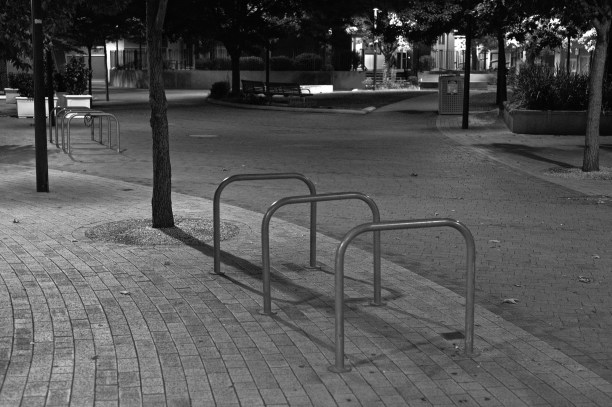
Empty street scene at night with bike racks in the foreground

There, diffused in artificial light, buried in shadows, fading into the black background, is the architecture of the absent working world: vacant bike racks, deserted streets, empty footpaths, silent coffee shops, soundless offices and customerless shops.

Counterpoised against this architecture of construction is the architecture of nature: planted trees, beds of wilted flowers, dried lawns. The constructed enhanced—and humanised— by nature. But there is nothing natural about this artificial entwining of the built and the grown. What is constructed is an overwhelming tension between the vacant now, the immoderate past and the dormant future.

Sometimes though, in this shadowed world of greys and blacks, are the signs and symbols of expressed life and half finished work.
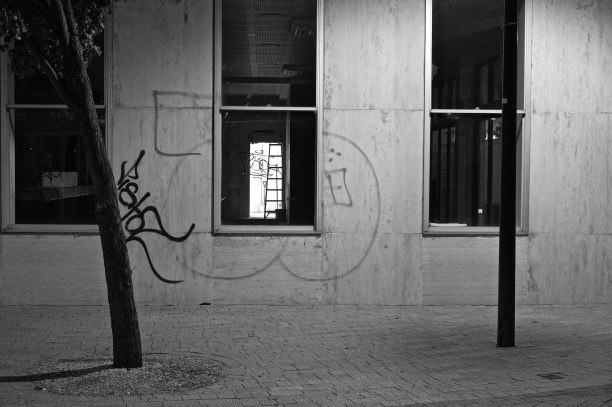
Night scene of wall with graffite

A workman’s ladder and shovel in an empty building. Graffiti. Sometimes a discarded bottle or can. Detritus of life; past life in progress; future life suspended in the unfinished past. Entropy facilitating time and life.

Yet these empty, dark, silent streets are not always so alien, so half-filled with life. Often they are also the backdrop to tragedy and comedy, to anguish and joy, to forgiveness and error, to compassion and hate. Private—or not so private—emotions shared in a public space. Hidden, but apparent to those who see.

Couple hugging in a street at night

Backdrop or not, empty, shadowed, back streets reflect the emptiness and shadowed cosmos in which we dwell. Perhaps, for me, they also reflect the inevitable emptiness and shadowless void of death which awaits me as it does all of us. Maybe this is why I am ambivalent towards such scenes: life hidden in the shadows of death.

Life is perverse.

On art exhibition openings — 2016-11-04

On art exhibition openings

Margaret, my lovely wife, is an artist whose media is photographs mediated and manipulated by Photoshop. So we go to all sorts of exhibition openings, like the one in the old wool shed a few days ago. It was the usual sort of opening. Drinks, snacks, people milling around, talking. A speech to open it.

feet-and-floor-_fup2332-small

Fortunately, the speaker did not clothe his talk in, what is to me, the usually incomprehensible ‘art speak’. Plain speaking, he was. Much appreciated.

Again, I was reminded that openings are not so much about presenting the art works to the public and taking sales, though these are certainly some of their intents. Rather, it seems to me that openings are primarily the opportunity for artists and other interested parties to network, to check up on what other artists are doing and to explore the latest trends and fashions in art. All worthy tasks.

On the other hand, as a somewhat interested party—interested in my wife’s art practice certainly—I tend to use openings to try to make sense of the art and what art is generally. I wander from work to work, often fighting my way through the milling interested parties, trying to understand what the artist(s) are saying, if anything, and to see if I can make sense of what’s on offer. Usually, I fail in these endeavours. Art, and what constitutes art, remains nebulous, a fog bound view of what I am told is a wonderful world of meaningful visual sensations, allegory and often social commentary.

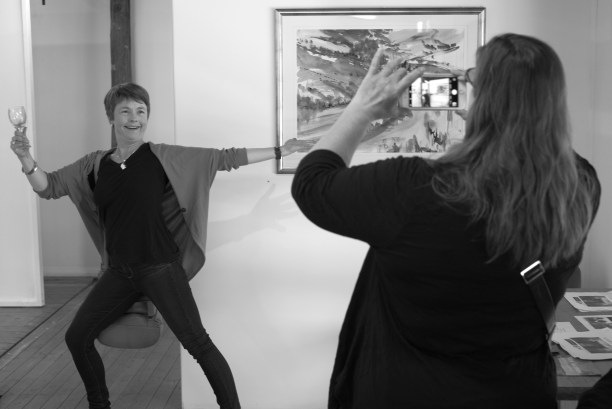
So it is not so surprising, then, that I usually find those who attend these events to be of more interest than the works themselves. And when one of the exhibiting artists performs for the cameras of the interested parties I get a greater insight into the nature of that artist than ever I could through their art.

a-happy-artist-_fup2351-smallIn the same way, my photographic interactions with those attending informs my deepening understanding of humanity and the perversity of people. Some notice me; some ignore me. Some willingly participate in my photographs; others question my activities—indirectly or directly.
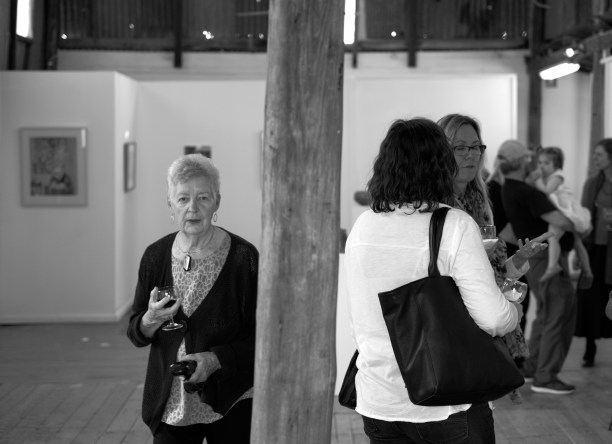
the-photographer-as-art-work-_fup2322-small

Overall, my sense is that art exhibition openings, like the art itself, reflect the human desire for creativity, social interaction, acceptance by others and personal growth (by both the artists and interested parties). Even if the openings are costumed in incomprehensible  ‘art speak’. As such, therefore, art exhibition openings are performances. Artistic performances. Installations even. Transient art. Invisible art. Human interaction as art. Perversity as art.

In the window — 2016-10-25

In the window

The other day I was wandering through our local shopping mall and noticed people standing around looking in a widow, just like these ladies.

Two ladie in a shopping centre looking to the right

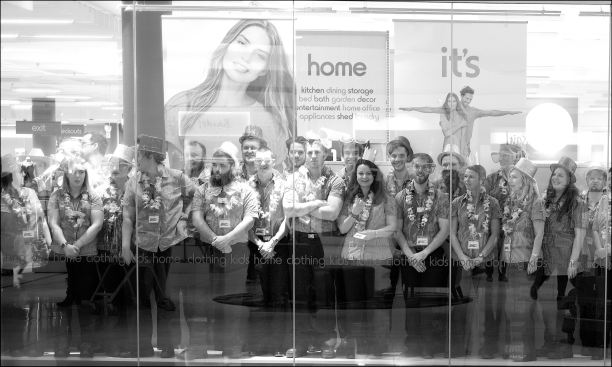
Intrigued, I turned to see what was the centre of attraction. To my surprise it was people in the window of one of the variety stores! I have no idea why they were there. But going by the uniforms they wore they were obviously employees of the store. And the store was obviously up to something. What was not clear.

Shop assistants in the window looking out at shoppers

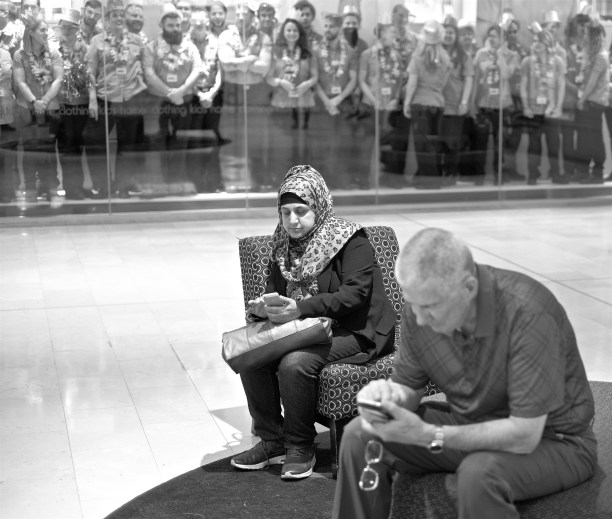
Yet not all the shoppers were immersed in this scene. Some showed distinct disinterest, even disdain, for the live mannequins.

Two people looking at their smart phones in front of a window filled with shop assistants looking at shoppers

Sometimes, it seems, what’s on our smart phones is more interesting than what’s around us in real life. Then again, maybe they’ve see it all before.

People can be perverse.