Words and images

Philosophy on the streets

At the beach — 2017-03-06

At the beach

Last week we spent a couple of days at the beach. Not that this was part of my recovering from surgery; we just wanted to spend time at the beach before the Summer ended. As it turned out this beach provided something of a—dare I call it?—spiritual experience. But I might also call it an existential one.

Our first walk along the seashore took us over a rocky headland. When viewed in a certain way, in a certain light, this seascape became an alien landscape. Alien mountain ranges, canyons, plains, indeterminate heights, depths and distances. A landscape forged by erosion; a monochrome landscape. Was this the primordial Earth? Was this a planet out beyond the galaxy?
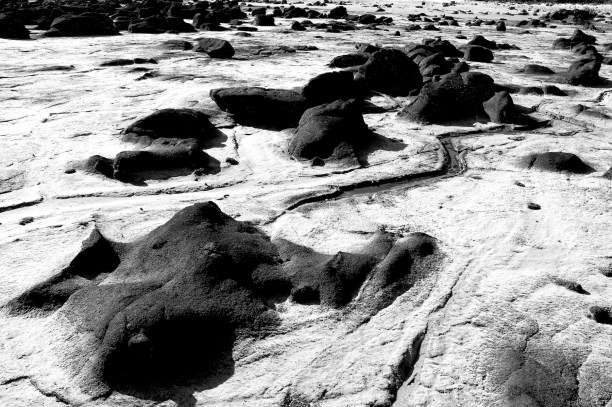
Photo of rocks on a beach

What was my role in this landscape? A (quantum) viewer giving life to the landscape? An integral part, each of us fulfilling a symbiotic relationship with the other? A maker of transient footprints, granted a snapped vision of the longevity of the non-organic and a fleeting glimpse of my irrelevance to its continuity?

Next morning we walked along the beach—away from the headland—empty of human life. We were in our own worlds, Margaret and I. She looked for pretty coloured shells and other organic detritus cast out of the everlasting waters. I listened to the crashing of the waves tens of metres out beyond the waves attempting to wet my feet. And I watched the light from the early morning sun as it played across the water, the waves and the beach.

Suddenly, I was transported to that alien planet I had discovered the previous day. But this time I imagined myself to be the alien, visiting this wondrous scene for the first time, feeling its beauty, its agelessness and its emptiness. These thoughts I wanted to share with Margaret but to speak—to utter sound—seemed sacrilegious. (It took some time for me to find an appropriate word for the experience.) For our beach had become a temple, a nursery of new life, a place of restfulness in a universe of harsh creation. An accident upon which I was happily meandering.

No image could capture that feeling; no words what I felt. Like the waves, my thoughts and feelings rose, peaked and collapsed, suffusing through my being. Awe, reverence, wonder. Then it was all gone. Words reappeared; the moment passed. Yet the beach—side lit by the rising sun—remained, unchanged and unaffected by my fleeting moments of wonder and magic.

People eventually returned to the beach, each to participate in their own way in the co-mingling of organic and inorganic.
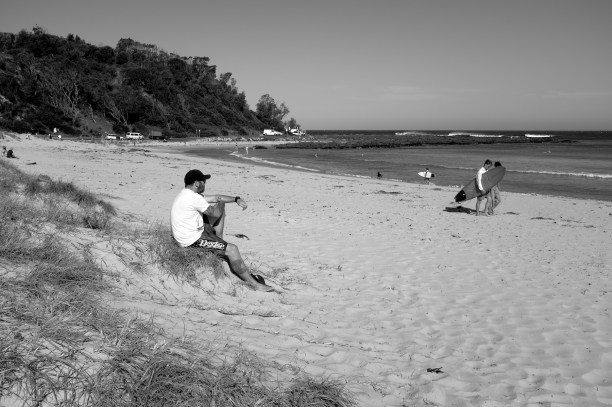
Photo of man sitting on a sandy outcrop watching people on a beach

We here in Australia tend to huddle in settlements constructed on or around beaches. For us they are resources to use and abuse as we choose. They give us pleasure, social opportunities, moments of reflection, relaxation, an opportunity to indulge our primal hunter instinct or to make money. Too often we take these wonders for granted; they become a simple backdrop against which we consume our lives and resources. On them we mark out a private place, claiming temporary ownership. Then the waves return and obliterate our intrusion onto the timelessness and alienness of beaches.
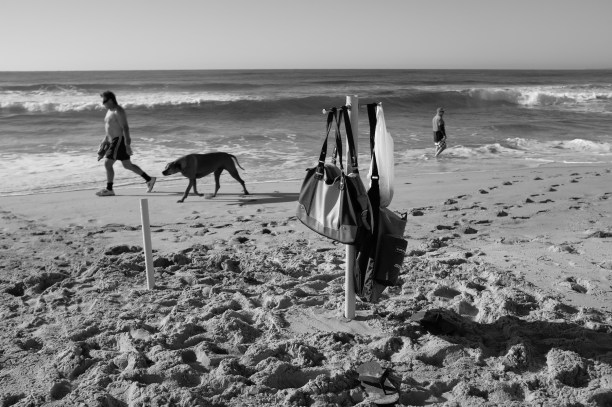
Photo of handbags suspended from a post embedded in a beach, with people walking by in the background

I do wonder who is the alien in this landscape.

On viewing historical objects — 2017-02-02

On viewing historical objects

The National Museum of Australia just closed its exhibition A history of the world in 100 objects with those 100 objects drawn from the very extensive collection of the British Museum. Objects ranged from stone tools to the prototype rig for Wi-Fi developed by the CSIRO (actually this was the 101st object). Naturally there was quite a bit of interest in the exhibition over the months it was open. And naturally that interest demonstrated itself in the queues awaiting admission.

People standing in a queue

But what was it that attracted our attention, that was worth the long, boring wait, and the quite reasonable admission price? The objects themselves; the stone, pottery, fabric, metals? That the objects were from the British Museum and so only available after a long, but relatively cheap, international flight? That the collection told the history of mankind, its technological progress from cave to radio wave connected portable electronic devices? Or its social and cultural evolution from rock art to modern art, represented respectively as a bison scratched on a piece of rock and a sketch of two male lovers in bed? Ultimately I guess each visitor had their own reasons for attending, their own need to extract meaning from the objects and the exhibition per se. From what I observed such needs were indeed met.

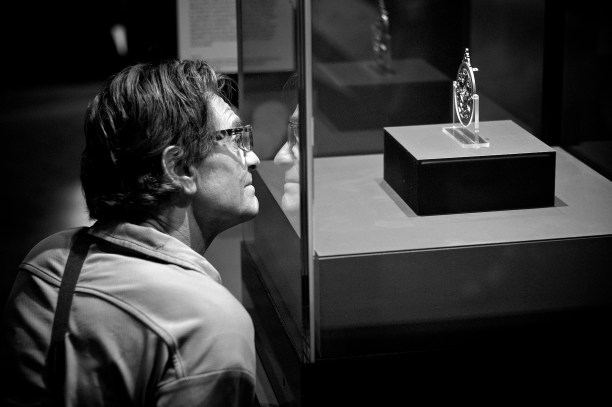
Setting aside these personal explorations for meaning, there is the larger question of why the objects were collected in the first place. Certainly the objects had an innate beauty or demonstrated great craftsmanship or had a practical use. Many required close inspection to appreciate what they were and the effort involved in their production.

Close up of a man looking at an object in a protective case

Detailed inspection was supplemented by detailed notes accompanying each object, satisfying the need to know what the object was and, to some extent, its historical context. From the notes and inspection one could begin to understand how each object gained its place in the collection and its role in the past.

What I found missing from the exhibition, however, was connection. Each object existed and was displayed in isolation from all others, connected only by way of their era-based arrangement. Yet no gestalt was provided to integrate the disparate objects, to make patterns, to form themes, to provide a framework for making historical sense and relating the past to the present and, indeed, to the future.

Hence, making sense of the collection as a collection—drawing links, comparing technologies and cultures, developing a deep understanding of the progress of humankind—was left to us as viewers.

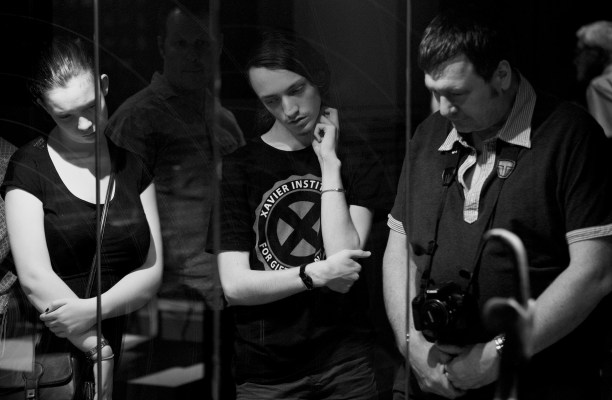
Thus, delving into our own history our own experiences we made sense—more or less—of all that we saw. Did this then make us participants in the exhibition? Were we the ultimate subject of the display? Were we, the viewers, also the omnipresent creator of each object? If so, my participation was akin to a cameo role in a play or movie. So overwhelming was the scope of this sense making—so diffuse and different were the objects—that my attempts at sense making—and meaning making—proved inadequate.

This is not to say that the exhibition was without merit. Far from it. To see in the one room objects representing 20 000 years of human endeavour is to highlight the continuity, creativity and persistence of humanity. It is to understand that we—our technologies, our cultures, our societies, each of us as an individual—are but part of a continuing story, the evolution of humanity. It is also to highlight just how fleeting we are, as individuals as technologies, as cultures and as societies. Finally, it is to acknowledge that in all we do each day history, personal and human, stands behind us as a shadow, watching us yet enticing us towards a future that will be as transient as our past. We, in turn, are often unaware of that shadow or ignore it and its lessons.

Three people looking down with another in the background looking over their shoulder

Without our history we are without context. Without an appreciation of our past, our future is without a foundation. One hundred objects do not a history make, but they do stand in place of all those and all that which has preceded us and upon whose existence we have created our own rich present and set the scene for our unknown future.

Here’s to made objects and their shadows.