Words and images

Philosophy on the streets

Mungo — 2018-06-20

Mungo

Mungo. Lake Mungo. Mungo Man/Lady. Three terms, each with overlapping meaning, each with a different meaning. Each different but the same.

Fifty thousand years ago there was a lake at what is now Mungo, in western New South Wales. A large lake, covering around 200 square kilometres filed with wildfowl, fish, molluscs and other watery creatures. Around the lake wandered huge animals, megafauna, such as diprotodons, protemnodons and Genyornis. Trees and other vegetation completed the picture of a pristine, life-rich environment.

Over the centuries and millennia the climate changed, becoming drier. The lake became smaller and smaller, eventually disappearing altogether. As the lake dried so the vegetation became less, and then scarce, as it remains today. For reasons not fully agreed, the megafauna died out, rather quickly in evolutionary timeframes. Today’s smaller native animals eek out a survival where once there was plenty.

Visiting Mungo today one is challenged to see where once was water, challenged to imagine the once lushness surrounds, the thriving fauna and flora; the plethora of life. In their stead one is overwhelmed by the starkness and raw beauty of the place. 
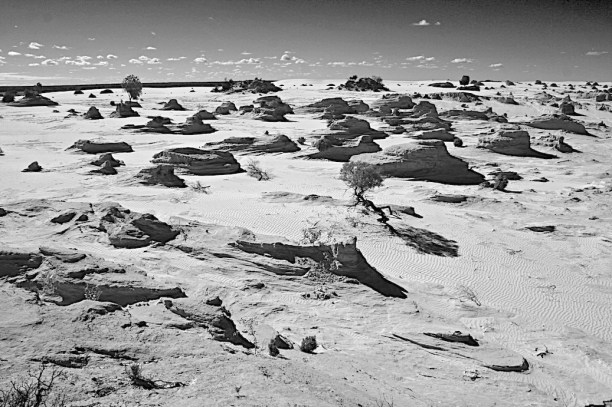
View of the lunettes at Mungo

Vistas of flat, dry landscape with trees disturbing the flatness of the horizon greet the hungry eye. Huge sand dunes—the Walls of China—stretch for about 33km on the eastern side of the lake bed. These are constantly reformed and relocated by winds without barriers. Lunettes, irregular formations of soil eroded by wind and occasional rain, provide a fairy land for the imagination. 

At night, as the moon rises from amongst the lunettes, the landscape is bathed in pale eerie light, like incomplete memories of precious moments past. Occasionally, lightening flashes over the distant horizon, a precursor to hoped for, but unlikely, rain.
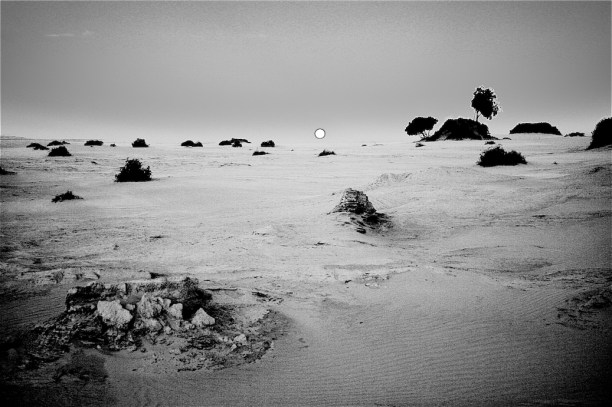
Picture of moon rising over the lunettes at Mungo

Wandering through the lunettes or around the vastness of the dry lake bed one comes upon the remnants of past life: long buried bones emerging from the soil. A small skull. Teeth; a jaw. Animals long dead like the long dead lake itself.
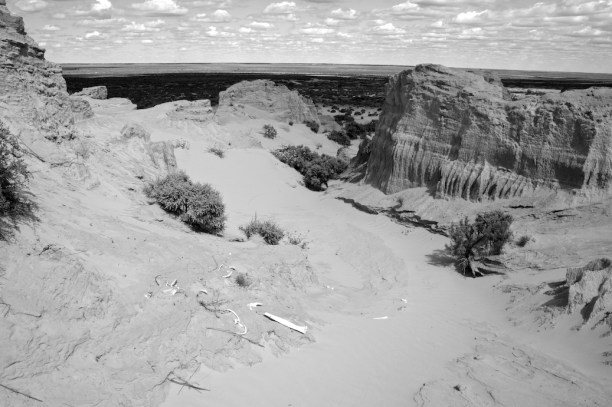
Picture of bones emerging from the soil at Mungo

Amongst these exposed remnants were found, in 1969, human bones, Mungo Lady. Two more sets of human remains were later found, including those of perhaps the world’s oldest known cremation. 

These people were from a culture that recognised death and maybe even the notion of a life after death. And they existed so long ago, at least 30 000 years in the past, perhaps up to 60 000 long years ago.

What changes the ghosts of these long buried peoples have seen and look down upon today. A landscape unrecognisable, a society without a sense of belonging, a peoples existing in splendid isolation from the elements, their food and the environment in which they live. Their descendants marginalised, wrapped in a long history, seeking acceptance, reconciliation and equality.

We live in the shadows of the Mungo people—or Universal Man, as Mungo had their contemporaries all across this wandering planet of ours, our Earth. We do not notice this shadow unless we still our minds and bodies and look around with eyes seeking the unseen, ears listening for the unheard and hands reaching for the touch of the untouched.

Mungo, lake and person; past, present and future co-existing and co-located. In time, we will all become like Mungo: a relic, bones in the sand, testaments to life long passed. What world will our ghosts look upon? What changes will they observe? What regrets will they hold? Will our bones become as sacred as those of Mungo? Unlikely, I think.

Meaning and cycle touring — 2018-02-16

Meaning and cycle touring

There’s a certain simplicity in cycle touring, a simplicity founded in routine. To get from A to B, perhaps via C, D, and E, one follows a pattern: arise, prepare for the day, ride, settle down at the end of the day. Repeat day after day after day after day until one finally arrives at B.

Simple routine. Profound meaning.

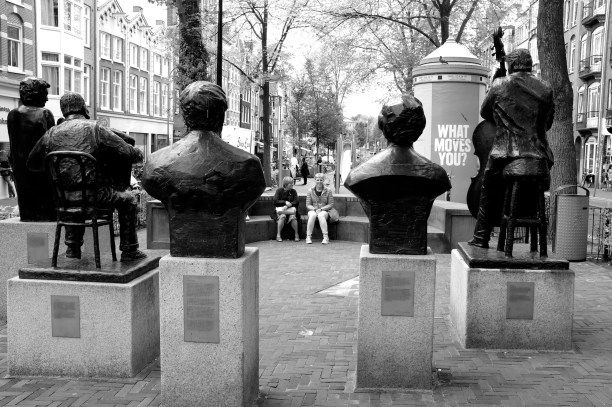
Bronze statue orchestra playing to a an audience of three women near a poster asking "What moves you?'

Meaning is construed by each of us according to our experiences, hopes, expectations. Different people attribute to the same act different meanings. Sometimes those meanings are similar, at other times they are quite different. But the meanings are never identical just as no two people are identical.

So cycle touring means different things to different people. It may mean escape (from other routines, from relationships, from the confines of urban life), adventure, self exploration and discovery, or simply the pleasure of being outside riding a bicycle, possibly in a new location or culture. It may be, at the one instant, all of these or none of them. Such is the vagary of meaning.

My reflection on cycle touring and its meaning is as a result of preparing a talk on my tour down the Rhine River, from Andermatt to Amsterdam. My mood is pensive, my reflections informed by a longing for escape to another fulfilling tour and the timelessness of retirement. Three episodes of mountain biking a week do not fill the gaps in my life, though they represent a routine. Checking email several times a day is not so much a routine as an expression of hope for interest, adventure, excitement, shortcomings in my life. Three meals a day become a bore, especially their preparation.

So my thoughts turn to a mobile life complemented by musings on the viability of living in a small space. With many fewer possessions. Too many of those I now have bind me to the past, both its highs and lows. Knowing this I remain unable—or is it unwilling?—to reduce the stockpile of things attesting to past life.

Woman sitting outside a fashion shop with people moving around her

Cycle touring requires small spaces—panniers, bar bags, back packs—and few possessions. There is no room in these small spaces for past life, other than those recorded in digital images and words. Space is required for those objects that maintain the routine of the tour: clothes, food, reading material (digital?), bicycle spares, digital devices and their accessories. Perhaps camping equipment, if essential to the tour.

Instead of ruminating on life’s past successes and failures, the touring cyclist ponders the next few kilometres or village, wondering what they will offer, how one will be affected by them. When thoughts do turn to the past those thoughts are of the life of the routine: past campsites, people met upon the trail, vistas, even mechanical matters. Experiences.

Experiences are the cornerstone of cycle touring, the building blocks of meaning, the creator of character. What the cycle tourist lacks in space is compensated for by an abundance of experiences, not all of which are pleasant, but all of which are meaningful.

To venture into the realm of cycle touring is to embark upon a quest for meaning, a quest mediated by routine. Don Quixote on a bicycle.

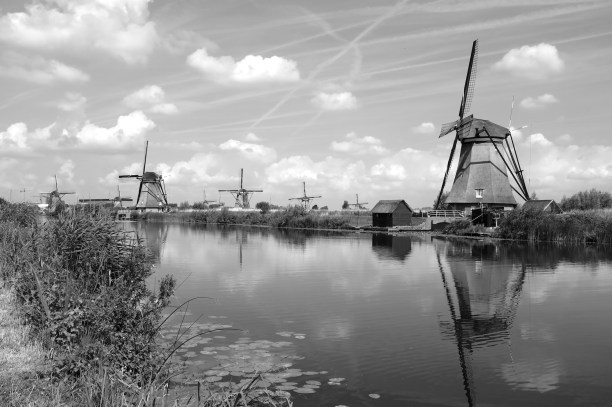
Windmills on the side of a canal

Cranes — 2017-10-08

Cranes

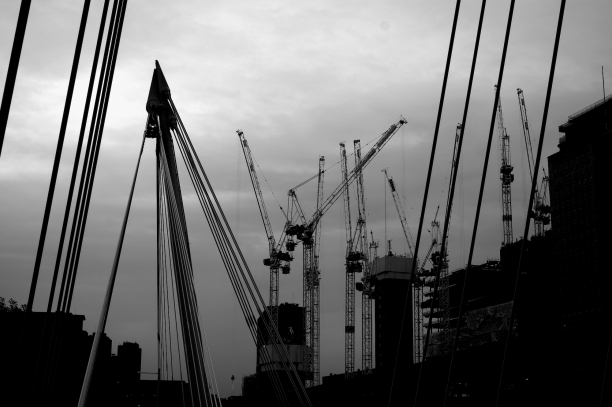
Cranes are a feature of most cities, decorating the landscape and horizon in larger or smaller numbers. They signal the rise of yet another building and, usually, the demise of the building—or buildings—that previously occupied that location. From man’s destruction arises yet another of man’s temporary creations.

Photo of cranes against a cloudy sky

Without cranes there would be no magnificent cathedrals, temples or mosques. There would be no skyscrapers. But there were the pyramids and other ancient buildings all constructed without the use of the technology represented by the cranes.

The Greeks are generally thought to have first invented the crane, powered by men or beasts. Later technologies, like the human powered treadmill, allowed greater loads to be manipulated and greater heights to be traversed. Over time new designs arose along with new uses: harbour cranes, mobile cranes on land and water, telescopic cranes, sidelift cranes; an endless variety. Steel replaced wood as the fabrication medium allowing even more power for lifting to ever greater heights.

So now cranes are just another instrument in man’s ever enlarging toolbox, another outcome of man’s ingenuity and his desire to make light of heavy work, to make the impossible (heights) possible. Cranes now blend into our cityscape, supplementing and even complementing those other constructions with which we adorn our urban environment.

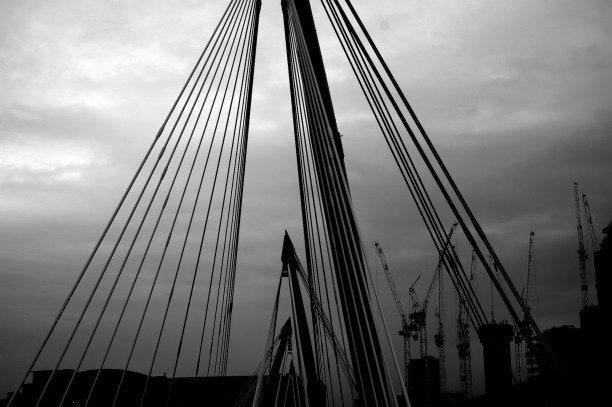
Photo of cranes and bridge structure against clouds

Yet, despite their proliferation, their imposing sight, their grandness—or perhaps because of it—we often fail to notice cranes altogether and remain oblivious to the simplicity that belies the modern form of these marvels of engineering. At its simplest a crane is a raised pulley (or smooth surface) over which passes a cable of some material to assist in raising or lowering a mass. So much technology, so much understanding of physics, so much engineering underpinning such a simple concept.

Look around you. Look for the technology that underpins our modern lives, that gives us what we have. Look for the physics at play in the world, look for and appreciate the engineering, the innovation that gives us our way of life. And look for cranes. You can find them in the most unexpected of places.

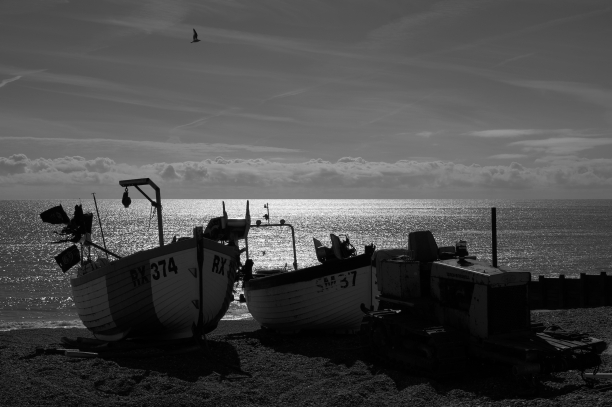
Photo of beached small fishing boats silhouetted against the sea

On ruins — 2017-09-23

On ruins

Cathedrals, mosques, temples. For millennia religious groups have sought to construct places of worship that reflect their particular faith and their aspirations for that faith and its followers. Sometimes these aspirations resulted in buildings that soared into the sky, highlighting the smallness of the worshippers in comparison to the greatness and powerfulness of their god. For some, such heights also offered the hope of bringing the worshippers closer to their god.

Occasionally this desire for closeness to god reflected more the foibles of human nature than the pureness of the human heart. This produced, for example and for a while, a ‘competition’ to build the highest cathedral in Europe.

Photo of

But the strength of faith and stone cannot withstand the strength of nature: rain, wind, earthquake, storm, tsunami, flood, fire. Combatting these eternal entropic processes requires of us constant vigilance and action. Despite the strength of faith of worshippers, despite their best efforts, despite their desire to glorify their god, their places of worship inevitably crumble, succumbing to nature’s constant buffeting.

Ruins are all that so often remain. Temples buried under verdant vines and trees, or disguised as farmland hillocks, or left as rocky half-walls on desolate moors or isolated islands. For some, however, ruination provides a continuing life, as tourist attraction where all religious connotations are replaced with historical, architectural or aesthetic values.

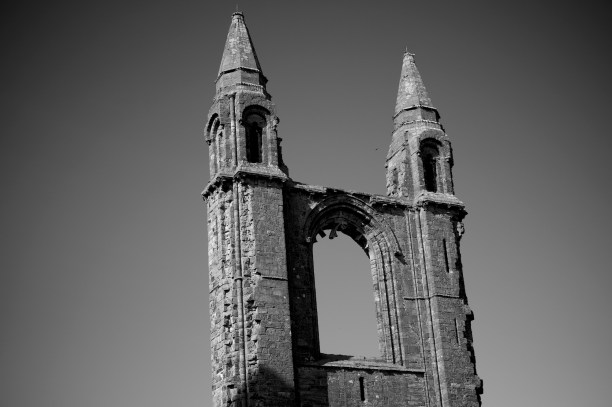
To our modern minds some ruins—those with more substance or preservation by current hands—conjure up visions of monsters, foreboding disaster, threatening even more ruination.

Photo of a ruined spire looking like a monster

Archaeologists and their brethren help us make sense of ruins whatever their condition, wherever they are found, whatever their original purpose. They bring to life those who built and used those before-ruins so offering us an informed view of the past.

At a larger scale, ruins allow us to see our future, personal, social, cultural and physical. Ruins inspire us, fill us with awe at the ever-there ingenuity, creativity and strength of our species. They make us wonder about who made the before-ruin, why they did, what happened in those places and, finally, why they ended up ruins at all. In this way ruins go some way to satisfying our always-there need to make sense of the world and our place in it.

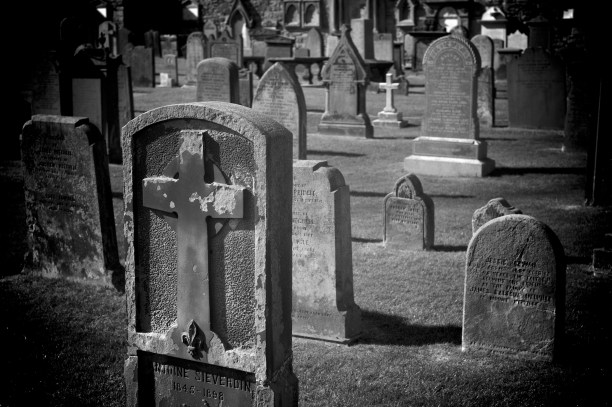
But ruins also remind us of our own eventual ruination, death. Yet even in death we have our ruins: the decaying, faded gravestones that attest to our existence, that say we were here, we made these ruins.

Photo of grave stones