Words and images

Philosophy on the streets

Shadows — 2016-12-05

Shadows

Shadows, those volumes of darkness beloved of visual creatives—painters, photographers, movie directors—enfold us in their invisibility. We see or do not see them as our mood varies, as our view dances from point to point creating a gestalt, even a story, of our reality.

We see the world writ large in shadows, often imposing, often subtle. For their part, shadows protect their charges in anonymity allowing our imagination to construct what is not, or is only partially, visible. Yet many objects under the influence of shadows use that protective cloak to display their own innate beauty, to create their own contrasting gestalt, their own story.
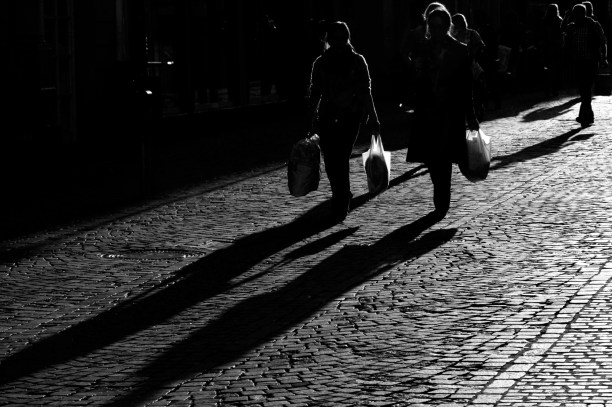
Backlit people walking down a cobblestone street

While most shadows are arbitrary, a product of the the interaction of the vagaries of nature—wind, sun, season, time of day—and object, others are deliberate creations. Amusements for our humour, our imagination, our sense of fun. We create, destroy, manipulate, intercept light just as we create, destroy, manipulate and intercept the physical and biological world so dependent on that light and its resultant shadows. Like us and their sibling natural shadows, created shadows are ephemeral. What remains after their passing is just a memory or an image of absence.
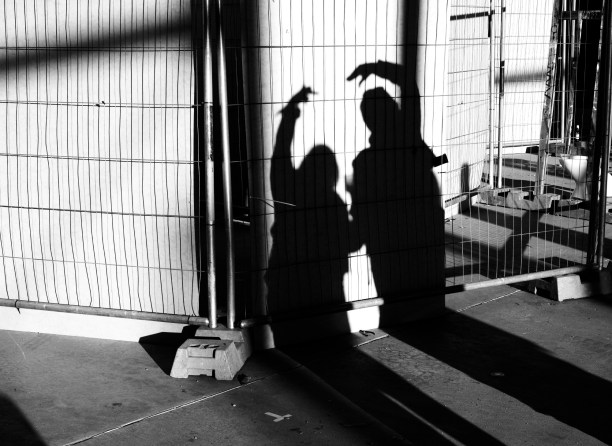
Shadows of two women creating an arc on a wall

By means deliberate or accidental, shadows can also reveal, through their absence, that which is there. Such non-shadows are as pervasive and invisible as the shadows with which they co-exist. And when they do reveal themsleves we forget the shadows and their old gestalt. Instead, we create a new gestalt, a new story, centred on the non-shadow. If we are lucky, or so inclined in our storytelling, that new story is richer, more fulsome and more profound than the old one told by the shadows alone.
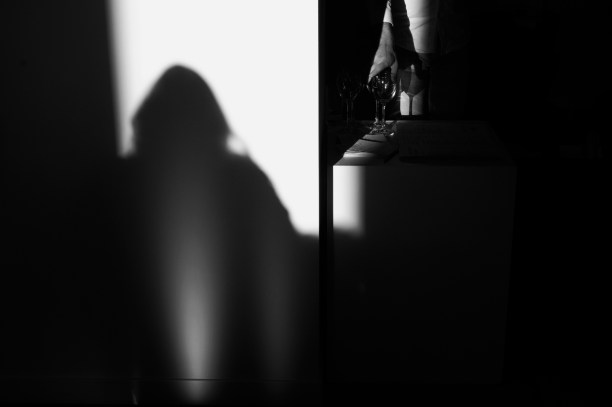
A shadowed hand reaching for a glass

It is these shadow/non-shadow stories that reflect our inner selves, that tell us who we are and where we stand in relation to light and the cloak of shadows.
Waiting for… — 2016-11-25

Waiting for…

Waiting is something we all do; often we have to wait too much or too long. Sometimes it seems we wait for just about everything. We waited when we went to Sydney last weekend for a family function. A birthday.

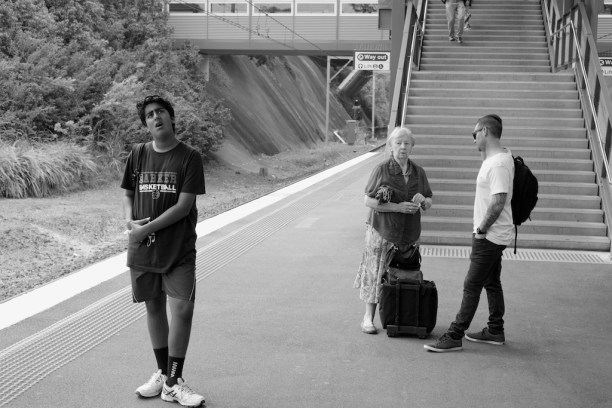
Our trip into town to visit an art gallery involved a decent amount of waiting, beginning at the station where we caught the train. There weren’t many people at the station, but those who were there were also waiting.

Young lad looking at the notice board at a railway station

Unfortunately, our trip was not the joyous event we were expecting. Our hosts were also waiting; waiting for an improvement in the health of a relative who was in hospital after suffering an apparent heart attack.

How we wait depends on many factors: the cause of the wait, what the waiting keeps us from, what’s around to fill our wait, how we view waiting, what’s worrying us at the time and so on. On the positive side, waiting can provide an opportunity to reflect, to catch up on reading, to… whatever. Today, our waiting is often mediated by technology.

_fup2684-mod-2

Eventually though our waiting is done and we resume our quest for whatever it was that the waiting delayed. We catch the train, we get to the front of the ticket queue, the guide for the tour arrives, we order our meal…

For our hosts, the outcome of the waiting came too soon: death of the relative. No longer were we waiting for the birthday party to begin (there would be no party). We were now waiting for an opportunity to leave so that our hosts could begin their grieving.

What began for us as a journey of joy, with expectant waiting, became a reminder of the uncertainty of life and the indetermination of waiting. We were reminded that although we know death, like a train, will eventually arrive out of the shadows of the future how we await its arrival is what really matters.

_fup2690-mod-3

Enjoy the wait.

On art exhibition openings — 2016-11-04

On art exhibition openings

Margaret, my lovely wife, is an artist whose media is photographs mediated and manipulated by Photoshop. So we go to all sorts of exhibition openings, like the one in the old wool shed a few days ago. It was the usual sort of opening. Drinks, snacks, people milling around, talking. A speech to open it.

feet-and-floor-_fup2332-small

Fortunately, the speaker did not clothe his talk in, what is to me, the usually incomprehensible ‘art speak’. Plain speaking, he was. Much appreciated.

Again, I was reminded that openings are not so much about presenting the art works to the public and taking sales, though these are certainly some of their intents. Rather, it seems to me that openings are primarily the opportunity for artists and other interested parties to network, to check up on what other artists are doing and to explore the latest trends and fashions in art. All worthy tasks.

On the other hand, as a somewhat interested party—interested in my wife’s art practice certainly—I tend to use openings to try to make sense of the art and what art is generally. I wander from work to work, often fighting my way through the milling interested parties, trying to understand what the artist(s) are saying, if anything, and to see if I can make sense of what’s on offer. Usually, I fail in these endeavours. Art, and what constitutes art, remains nebulous, a fog bound view of what I am told is a wonderful world of meaningful visual sensations, allegory and often social commentary.

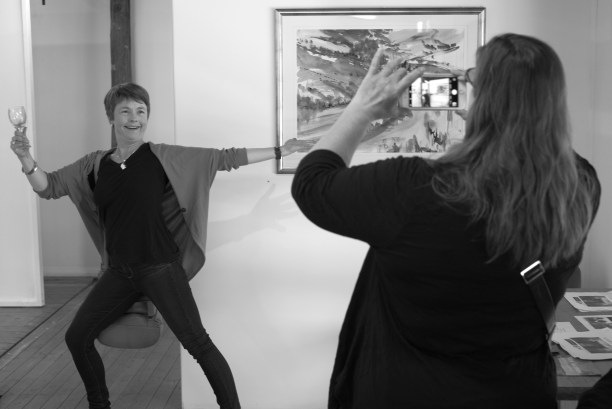
So it is not so surprising, then, that I usually find those who attend these events to be of more interest than the works themselves. And when one of the exhibiting artists performs for the cameras of the interested parties I get a greater insight into the nature of that artist than ever I could through their art.

a-happy-artist-_fup2351-smallIn the same way, my photographic interactions with those attending informs my deepening understanding of humanity and the perversity of people. Some notice me; some ignore me. Some willingly participate in my photographs; others question my activities—indirectly or directly.
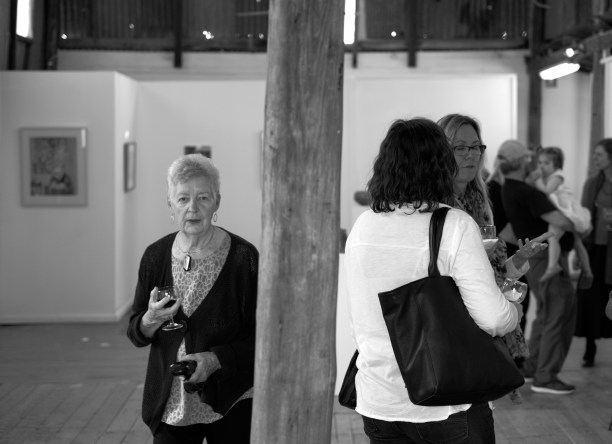
the-photographer-as-art-work-_fup2322-small

Overall, my sense is that art exhibition openings, like the art itself, reflect the human desire for creativity, social interaction, acceptance by others and personal growth (by both the artists and interested parties). Even if the openings are costumed in incomprehensible  ‘art speak’. As such, therefore, art exhibition openings are performances. Artistic performances. Installations even. Transient art. Invisible art. Human interaction as art. Perversity as art.

In the window — 2016-10-25

In the window

The other day I was wandering through our local shopping mall and noticed people standing around looking in a widow, just like these ladies.

Two ladie in a shopping centre looking to the right

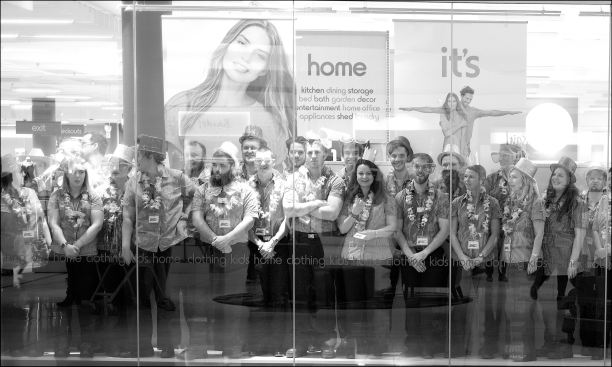
Intrigued, I turned to see what was the centre of attraction. To my surprise it was people in the window of one of the variety stores! I have no idea why they were there. But going by the uniforms they wore they were obviously employees of the store. And the store was obviously up to something. What was not clear.

Shop assistants in the window looking out at shoppers

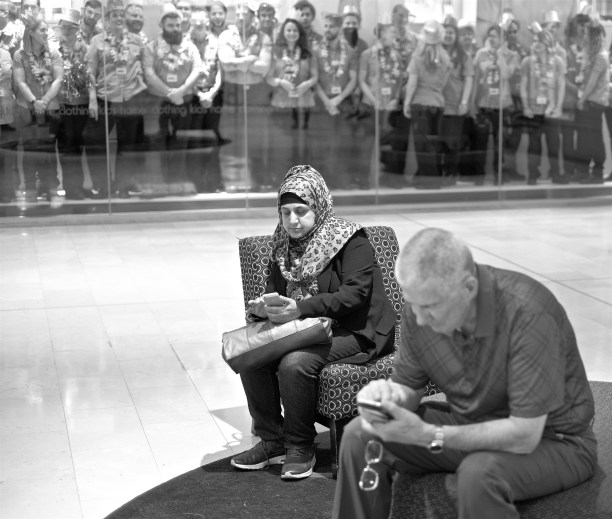
Yet not all the shoppers were immersed in this scene. Some showed distinct disinterest, even disdain, for the live mannequins.

Two people looking at their smart phones in front of a window filled with shop assistants looking at shoppers

Sometimes, it seems, what’s on our smart phones is more interesting than what’s around us in real life. Then again, maybe they’ve see it all before.

People can be perverse.