Words and images

Philosophy on the streets

On viewing historical objects — 2017-02-02

On viewing historical objects

The National Museum of Australia just closed its exhibition A history of the world in 100 objects with those 100 objects drawn from the very extensive collection of the British Museum. Objects ranged from stone tools to the prototype rig for Wi-Fi developed by the CSIRO (actually this was the 101st object). Naturally there was quite a bit of interest in the exhibition over the months it was open. And naturally that interest demonstrated itself in the queues awaiting admission.

People standing in a queue

But what was it that attracted our attention, that was worth the long, boring wait, and the quite reasonable admission price? The objects themselves; the stone, pottery, fabric, metals? That the objects were from the British Museum and so only available after a long, but relatively cheap, international flight? That the collection told the history of mankind, its technological progress from cave to radio wave connected portable electronic devices? Or its social and cultural evolution from rock art to modern art, represented respectively as a bison scratched on a piece of rock and a sketch of two male lovers in bed? Ultimately I guess each visitor had their own reasons for attending, their own need to extract meaning from the objects and the exhibition per se. From what I observed such needs were indeed met.

Setting aside these personal explorations for meaning, there is the larger question of why the objects were collected in the first place. Certainly the objects had an innate beauty or demonstrated great craftsmanship or had a practical use. Many required close inspection to appreciate what they were and the effort involved in their production.
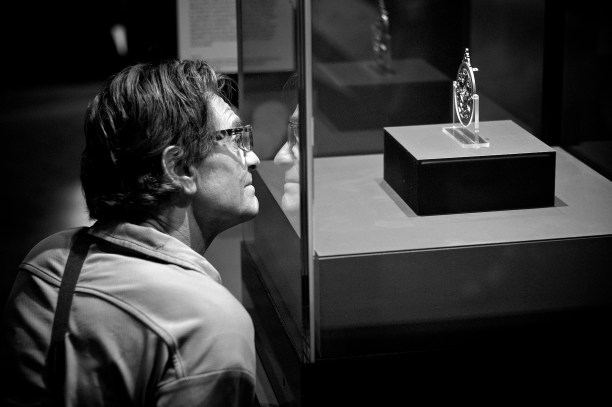
Close up of a man looking at an object in a protective case

Detailed inspection was supplemented by detailed notes accompanying each object, satisfying the need to know what the object was and, to some extent, its historical context. From the notes and inspection one could begin to understand how each object gained its place in the collection and its role in the past.

What I found missing from the exhibition, however, was connection. Each object existed and was displayed in isolation from all others, connected only by way of their era-based arrangement. Yet no gestalt was provided to integrate the disparate objects, to make patterns, to form themes, to provide a framework for making historical sense and relating the past to the present and, indeed, to the future.

Hence, making sense of the collection as a collection—drawing links, comparing technologies and cultures, developing a deep understanding of the progress of humankind—was left to us as viewers.

Thus, delving into our own history our own experiences we made sense—more or less—of all that we saw. Did this then make us participants in the exhibition? Were we the ultimate subject of the display? Were we, the viewers, also the omnipresent creator of each object? If so, my participation was akin to a cameo role in a play or movie. So overwhelming was the scope of this sense making—so diffuse and different were the objects—that my attempts at sense making—and meaning making—proved inadequate.

This is not to say that the exhibition was without merit. Far from it. To see in the one room objects representing 20 000 years of human endeavour is to highlight the continuity, creativity and persistence of humanity. It is to understand that we—our technologies, our cultures, our societies, each of us as an individual—are but part of a continuing story, the evolution of humanity. It is also to highlight just how fleeting we are, as individuals as technologies, as cultures and as societies. Finally, it is to acknowledge that in all we do each day history, personal and human, stands behind us as a shadow, watching us yet enticing us towards a future that will be as transient as our past. We, in turn, are often unaware of that shadow or ignore it and its lessons.
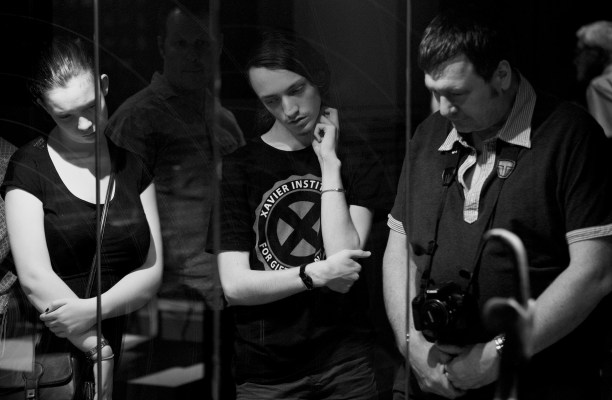
Three people looking down with another in the background looking over their shoulder

Without our history we are without context. Without an appreciation of our past, our future is without a foundation. One hundred objects do not a history make, but they do stand in place of all those and all that which has preceded us and upon whose existence we have created our own rich present and set the scene for our unknown future.

Here’s to made objects and their shadows.

Escalators and life — 2017-01-20

Escalators and life

Between Christmas and New Year I came off my bike, a mountain bike. I was riding around a corner—quite open, loose track and no camber to speak of—when the bike slipped in the gravel and brought me to a hard landing on my left knee.

One of the features of riding a mountain bike—and probably any bike for that matter—is that because you have successfully negotiated a track innumerable times does not mean that you are immune from succumbing to its vagaries at some time in the future. It’s not about luck or skill or concentration, though all are important when riding, as they are in life. It’s just that shit happens without consultation or consideration of the consequences. And we are left to deal with those consequences. Which is why I am now laying in a hospital bed awaiting the next bout of surgery on my injured knee.

Those vagaries that apply to mountain biking have their analogues in all aspects of life. While we might like life to be like riding an escalator—constant, predicable, known up or down, easy to access and exit, smooth going—it isn’t. It’s quite the opposite.

escalator-of-certainty-_fup3467-version-3

I rode the escalator of life—and mountain biking—to my satisfaction. Well, to as much satisfaction as could reasonably be expected from life anyway. Of course there were times when I, like everyone else, stood at the bottom of a set of escalators wondering which I should take. Up or down? What opportunities awaited me at the end of each ride? Possibly more importantly, what opportunities would I miss by taking one escalator and foregoing the other?

Photo of two people standing and the bottom of a set of escalators

Yes, I could ride both, but opportunity has this tendency to be fleeting. While I am half way up the up side, it is disappearing into the depths of the down side, for instance.

But if I have set out with a specific objective in mind, if I know it’s at the end of one specific escalator, surely that’s a different matter? Maybe. With all the ‘opportunities’ surrounding escalators—the shops, people, alley ways, dark corners—it is all too easy to loose sight of our objective(s). Maintaining a single-mindedness in the world of attractive and desirable opportunities is difficult. In many ways it’s about knowing the landscape of escalators, keeping our objectives in the forefront of our minds and then seeking only those opportunities that contribute to our objectives.

In this way an escalator is neither up nor down. It simply is a way of following opportunities. As such all escalators are up taking us towards where we want to be.

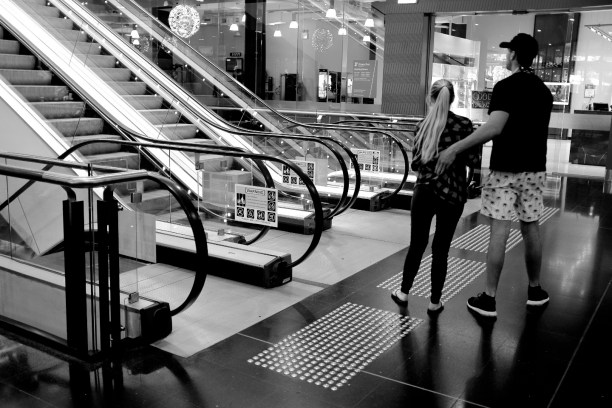
Photo of two escalators that both appear to be going in the same direction

New Year and ephemeral change — 2017-01-02

New Year and ephemeral change

2017 is now upon us. For many of us a new year brings hope of a different, if not better, life than we had in the previous (and previous and previous and previous…) year. After all, that’s why we bother with New Year’s resolutions: great aspirational goals, too short lived in the doing, and too ineffective in the end. One might even suggest that such resolutions are (too) simple solutions to complex problems of human behaviour. But at least they represent good intentions for all their shortcomings.

When deciding we want to change something—our life, our car, our family, whatever—we compare what we now have with what we believe we will have after the change. Sort of like looking one way then the other before stepping out to cross a road.

Looking one way we see the past. Memories of its failures, its barriers, its highlights, it’s nitty grittiness. But the shadows of that past, in which we now live, are strong, deep and pervasive. In them are buried lost and forgotten dreams, deeds and decisions. It is from this ghost that we wish to escape. Hence, we seek change.

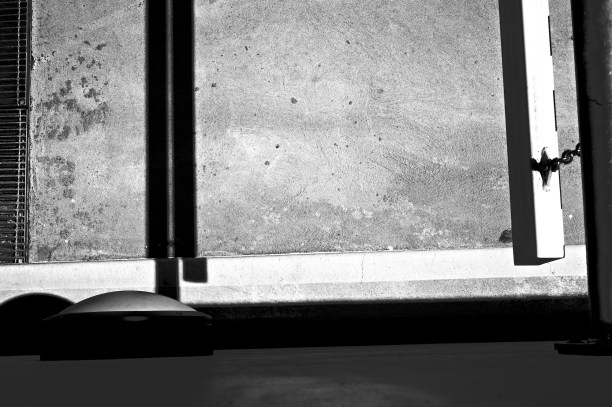
Gritty photo of concrete

So we look the other way, longing to see a future quite remote from the past. An open door leading to somewhere different and better, somewhere safer, somewhere in which we can escape the shadows of our past and feel cosseted from life’s too-great challenges and threats.

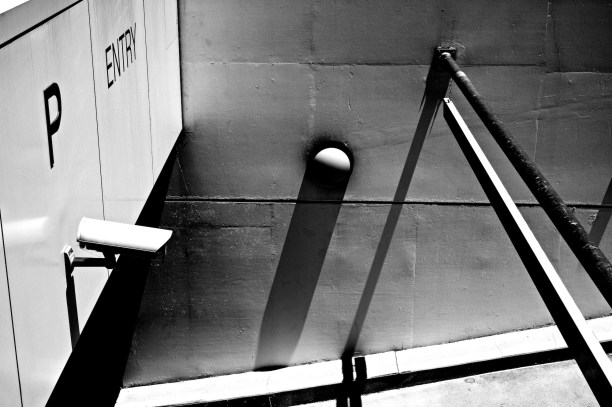
Gritty photo of entry into underground parking lot

For some—those who embrace change and persevere with its implementation—that open door does indeed lead to fulfilled expectations. These few are reborn, renewed, reinvigorated, their resolutions achieved.

Yet for the remainder—the vast majority—change is ephemeral. It remains but a desire, wishful thinking, providing comfort through imagination. The cost of change is too high, its benefits too low. So we maintain the status quo. But not quite.

In the act of seeking change we have indeed changed. Recognising the need to change takes us one step closer to that open door of idealised future. Meanwhile, our haunting shadows remain, but with less oppression; our challenges become clearer; our perspective broader. All the while the nitty gritty of our life continues to both repel and attract us.

Another gritty photo of concrete floor

Life surely is perverse.

The empty night — 2016-12-22

The empty night

Empty city streets have always fascinated me, filled me with an emotion I cannot name.

My first exposure to this phenomenon—and when I first recognised it—was in London in the mid-1970s. Walking through the back streets towards Baker Street (to check out Sherlock’s abode, of course) generated this feeling of emptiness, of spaciousness, of loneliness, of the lack of life, human or otherwise.

A decade later, the same emotions arose, but in a different set of back streets.

Since then the feelings have come and gone as I explored and wondered the back streets of various cities around the world.

Always that feeling of emptiness and loneliness; of something alien.

Back streets at night are even more poignant and emotive.

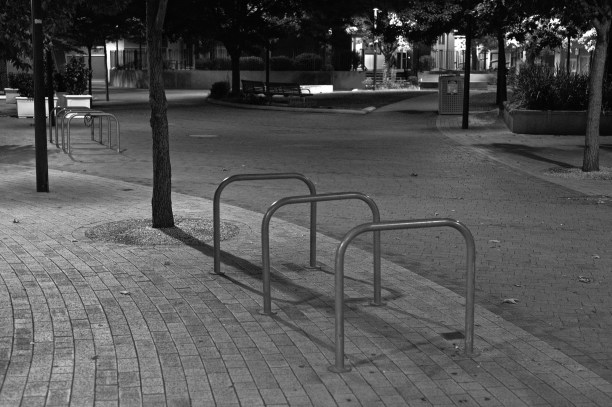
Empty street scene at night with bike racks in the foreground

There, diffused in artificial light, buried in shadows, fading into the black background, is the architecture of the absent working world: vacant bike racks, deserted streets, empty footpaths, silent coffee shops, soundless offices and customerless shops.

Counterpoised against this architecture of construction is the architecture of nature: planted trees, beds of wilted flowers, dried lawns. The constructed enhanced—and humanised— by nature. But there is nothing natural about this artificial entwining of the built and the grown. What is constructed is an overwhelming tension between the vacant now, the immoderate past and the dormant future.

Sometimes though, in this shadowed world of greys and blacks, are the signs and symbols of expressed life and half finished work.

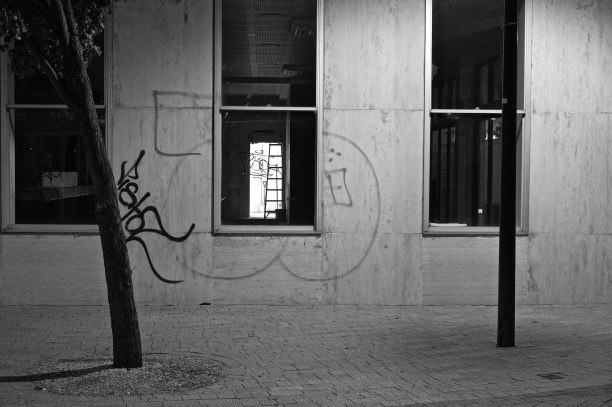
Night scene of wall with graffite

A workman’s ladder and shovel in an empty building. Graffiti. Sometimes a discarded bottle or can. Detritus of life; past life in progress; future life suspended in the unfinished past. Entropy facilitating time and life.

Yet these empty, dark, silent streets are not always so alien, so half-filled with life. Often they are also the backdrop to tragedy and comedy, to anguish and joy, to forgiveness and error, to compassion and hate. Private—or not so private—emotions shared in a public space. Hidden, but apparent to those who see.

Couple hugging in a street at night

Backdrop or not, empty, shadowed, back streets reflect the emptiness and shadowed cosmos in which we dwell. Perhaps, for me, they also reflect the inevitable emptiness and shadowless void of death which awaits me as it does all of us. Maybe this is why I am ambivalent towards such scenes: life hidden in the shadows of death.

Life is perverse.