Words and images

Philosophy on the streets

Cranes — 2017-10-08

Cranes

Cranes are a feature of most cities, decorating the landscape and horizon in larger or smaller numbers. They signal the rise of yet another building and, usually, the demise of the building—or buildings—that previously occupied that location. From man’s destruction arises yet another of man’s temporary creations.
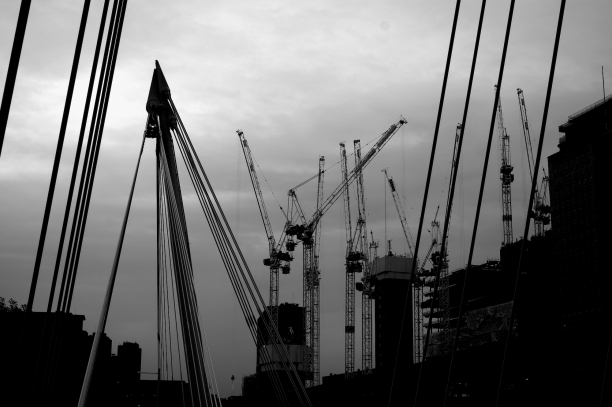
Photo of cranes against a cloudy sky

Without cranes there would be no magnificent cathedrals, temples or mosques. There would be no skyscrapers. But there were the pyramids and other ancient buildings all constructed without the use of the technology represented by the cranes.

The Greeks are generally thought to have first invented the crane, powered by men or beasts. Later technologies, like the human powered treadmill, allowed greater loads to be manipulated and greater heights to be traversed. Over time new designs arose along with new uses: harbour cranes, mobile cranes on land and water, telescopic cranes, sidelift cranes; an endless variety. Steel replaced wood as the fabrication medium allowing even more power for lifting to ever greater heights.

So now cranes are just another instrument in man’s ever enlarging toolbox, another outcome of man’s ingenuity and his desire to make light of heavy work, to make the impossible (heights) possible. Cranes now blend into our cityscape, supplementing and even complementing those other constructions with which we adorn our urban environment.
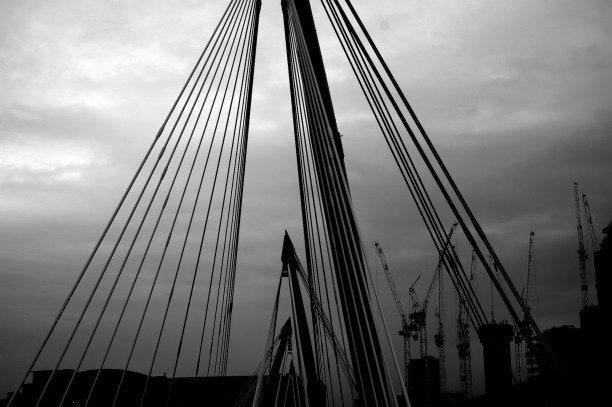
Photo of cranes and bridge structure against clouds

Yet, despite their proliferation, their imposing sight, their grandness—or perhaps because of it—we often fail to notice cranes altogether and remain oblivious to the simplicity that belies the modern form of these marvels of engineering. At its simplest a crane is a raised pulley (or smooth surface) over which passes a cable of some material to assist in raising or lowering a mass. So much technology, so much understanding of physics, so much engineering underpinning such a simple concept.

Look around you. Look for the technology that underpins our modern lives, that gives us what we have. Look for the physics at play in the world, look for and appreciate the engineering, the innovation that gives us our way of life. And look for cranes. You can find them in the most unexpected of places.
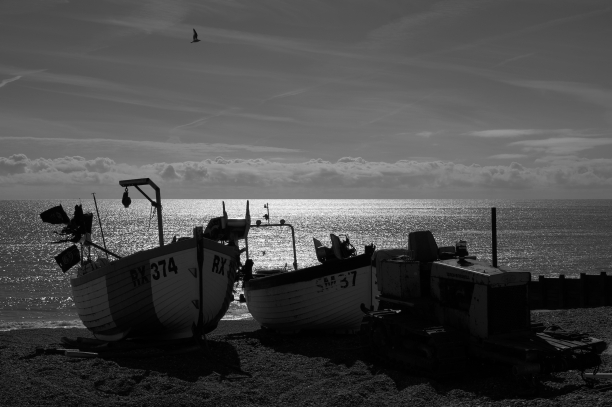
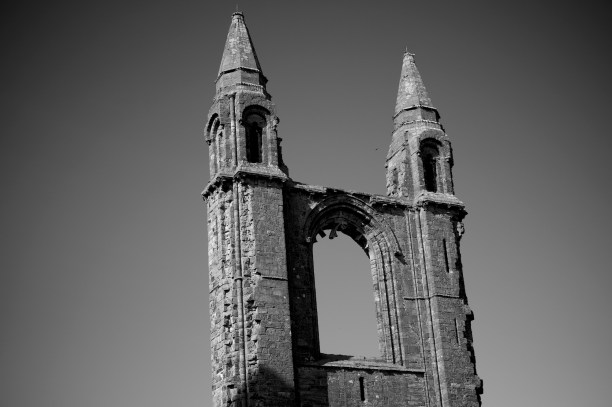
Photo of beached small fishing boats silhouetted against the sea

On ruins — 2017-09-23

On ruins

Cathedrals, mosques, temples. For millennia religious groups have sought to construct places of worship that reflect their particular faith and their aspirations for that faith and its followers. Sometimes these aspirations resulted in buildings that soared into the sky, highlighting the smallness of the worshippers in comparison to the greatness and powerfulness of their god. For some, such heights also offered the hope of bringing the worshippers closer to their god.

Occasionally this desire for closeness to god reflected more the foibles of human nature than the pureness of the human heart. This produced, for example and for a while, a ‘competition’ to build the highest cathedral in Europe.

Photo of

But the strength of faith and stone cannot withstand the strength of nature: rain, wind, earthquake, storm, tsunami, flood, fire. Combatting these eternal entropic processes requires of us constant vigilance and action. Despite the strength of faith of worshippers, despite their best efforts, despite their desire to glorify their god, their places of worship inevitably crumble, succumbing to nature’s constant buffeting.

Ruins are all that so often remain. Temples buried under verdant vines and trees, or disguised as farmland hillocks, or left as rocky half-walls on desolate moors or isolated islands. For some, however, ruination provides a continuing life, as tourist attraction where all religious connotations are replaced with historical, architectural or aesthetic values.

To our modern minds some ruins—those with more substance or preservation by current hands—conjure up visions of monsters, foreboding disaster, threatening even more ruination.

Photo of a ruined spire looking like a monster

Archaeologists and their brethren help us make sense of ruins whatever their condition, wherever they are found, whatever their original purpose. They bring to life those who built and used those before-ruins so offering us an informed view of the past.

At a larger scale, ruins allow us to see our future, personal, social, cultural and physical. Ruins inspire us, fill us with awe at the ever-there ingenuity, creativity and strength of our species. They make us wonder about who made the before-ruin, why they did, what happened in those places and, finally, why they ended up ruins at all. In this way ruins go some way to satisfying our always-there need to make sense of the world and our place in it.

But ruins also remind us of our own eventual ruination, death. Yet even in death we have our ruins: the decaying, faded gravestones that attest to our existence, that say we were here, we made these ruins.

Photo of grave stones

On the ferry — 2017-06-01

On the ferry

One of the most egalitarian forms of public transport must be the ferry. These vessels cross untold numbers of rivers and coastal straits and link unbridgeable islands. Without them tens (hundreds?) of thousands (millions?) of people would have their travel freedoms tightly constrained. Regrettably, not all ferries are equal, especially in regards to safety.

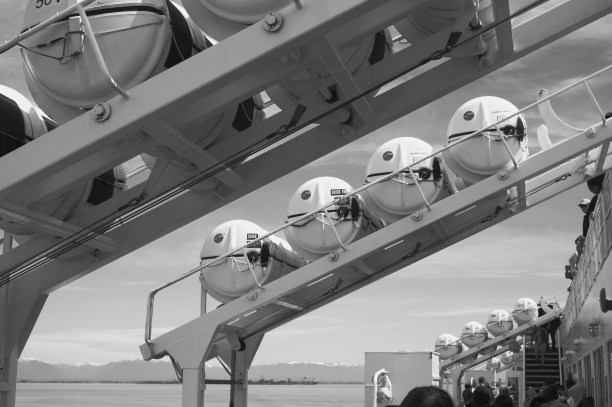
Ferry passengers in some parts of the world willingly venture onto overcrowded vessels with woefully inadequate life safety measures just because this is the only way to reach their destination. In consequence, lives are lost when the vessel capsizes, hits rocks or otherwise comes to grief. Other parts of the world, however, strictly govern and manage both passenger and ship safety. Of course, the cost of a ferry journey reflects these different levels of safety, amongst other factors.

Photo of life rafts on a ferry

Once on board a ferry, though, life continues. Upper and lower decks become the centre of this life for passengers. Here they eat, sleep, converse and look at the scenery according to their tastes and needs. Some ferries cater to these life needs by providing extensive on board facilities like restaurants, wifi, private cabins, games rooms for children (adults have to make do with cabins) and charging points for mobile phones and computers. Other ferries provide transport alone, with everything else provided by the passengers.

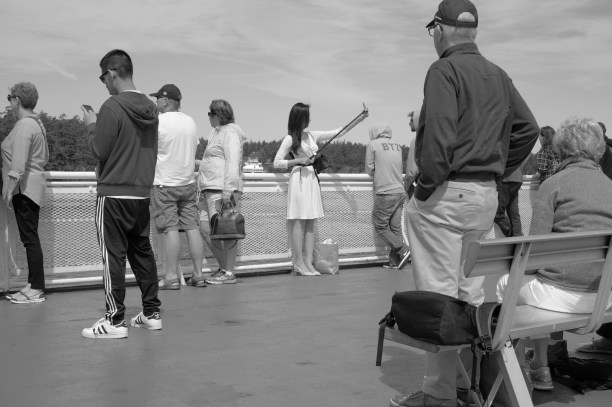
But being on a ferry is not part of ‘normal’ life for many passengers; it’s an occasional experience. So to remember the experience these infrequent ferry travellers take photos just as they take photos wherever they go. (Who doesn’t have a camera these days, if only it’s the one in their mobile phone?) Selfies are common, demonstrating for others that the passenger actually was there. (So no, it’s not a postcard I bought at some expense from the gift shop on board the ferry.) Group selfies (grelpies?) bond friends by providing memories of shared moments. Such moments of sharing remove the group members from the hustle and bustle of life on board the ferry and provide brief moments of shared solidarity. And when selfies and grelpies are published on social media it again demonstrates to the world that I was here. See what you are missing. Envy generated large across the internet.

Photo of a lady on the deck of a ferry taking a selfie while surrounded by passengers

But, why did I say that ferries are egalitarian? Simply because going on a ferry trip is generally open to every man, woman and their dog. And if a ferry gets into trouble everyone aboard is equally affected. Storms can’t be paid to weaken, shoals can’t be bought off, poor internet connections affect all passengers. While some passengers may suffer these events in the comfort of an expensive state room, when the ferry goes down, it’s everyone to the life rafts. And then the real nature of each passenger is displayed for all other passengers, and often, the world to see. Thanks goodness for the internet.

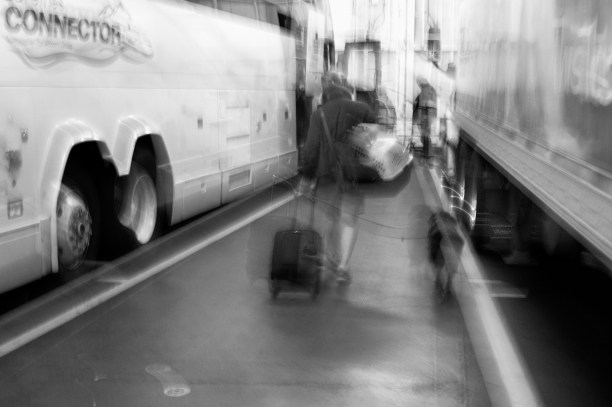
Photo of a man and a dog boarding a bus on a ferry

At the beach — 2017-03-06

At the beach

Last week we spent a couple of days at the beach. Not that this was part of my recovering from surgery; we just wanted to spend time at the beach before the Summer ended. As it turned out this beach provided something of a—dare I call it?—spiritual experience. But I might also call it an existential one.

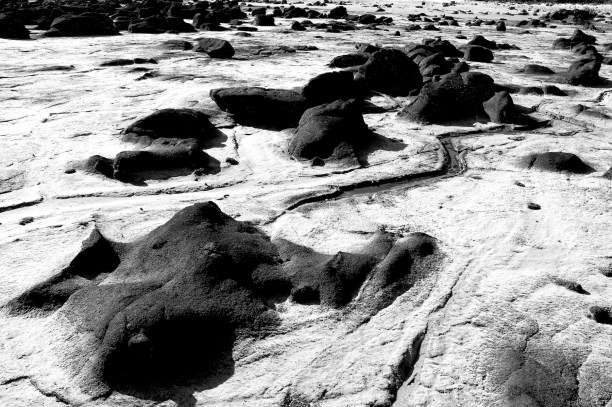
Our first walk along the seashore took us over a rocky headland. When viewed in a certain way, in a certain light, this seascape became an alien landscape. Alien mountain ranges, canyons, plains, indeterminate heights, depths and distances. A landscape forged by erosion; a monochrome landscape. Was this the primordial Earth? Was this a planet out beyond the galaxy?

Photo of rocks on a beach

What was my role in this landscape? A (quantum) viewer giving life to the landscape? An integral part, each of us fulfilling a symbiotic relationship with the other? A maker of transient footprints, granted a snapped vision of the longevity of the non-organic and a fleeting glimpse of my irrelevance to its continuity?

Next morning we walked along the beach—away from the headland—empty of human life. We were in our own worlds, Margaret and I. She looked for pretty coloured shells and other organic detritus cast out of the everlasting waters. I listened to the crashing of the waves tens of metres out beyond the waves attempting to wet my feet. And I watched the light from the early morning sun as it played across the water, the waves and the beach.

Suddenly, I was transported to that alien planet I had discovered the previous day. But this time I imagined myself to be the alien, visiting this wondrous scene for the first time, feeling its beauty, its agelessness and its emptiness. These thoughts I wanted to share with Margaret but to speak—to utter sound—seemed sacrilegious. (It took some time for me to find an appropriate word for the experience.) For our beach had become a temple, a nursery of new life, a place of restfulness in a universe of harsh creation. An accident upon which I was happily meandering.

No image could capture that feeling; no words what I felt. Like the waves, my thoughts and feelings rose, peaked and collapsed, suffusing through my being. Awe, reverence, wonder. Then it was all gone. Words reappeared; the moment passed. Yet the beach—side lit by the rising sun—remained, unchanged and unaffected by my fleeting moments of wonder and magic.

People eventually returned to the beach, each to participate in their own way in the co-mingling of organic and inorganic.

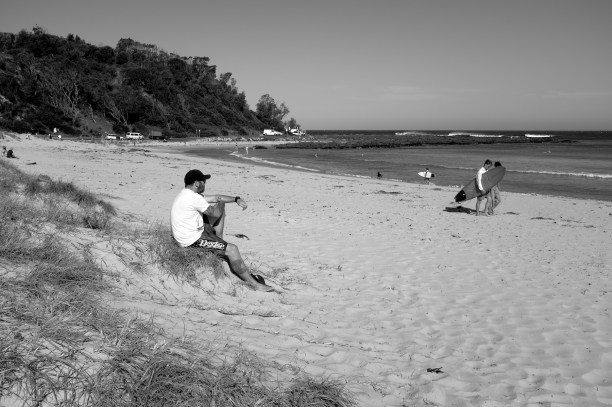
Photo of man sitting on a sandy outcrop watching people on a beach

We here in Australia tend to huddle in settlements constructed on or around beaches. For us they are resources to use and abuse as we choose. They give us pleasure, social opportunities, moments of reflection, relaxation, an opportunity to indulge our primal hunter instinct or to make money. Too often we take these wonders for granted; they become a simple backdrop against which we consume our lives and resources. On them we mark out a private place, claiming temporary ownership. Then the waves return and obliterate our intrusion onto the timelessness and alienness of beaches.

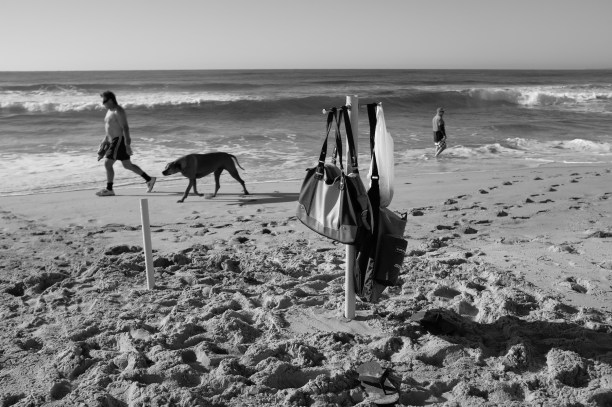
Photo of handbags suspended from a post embedded in a beach, with people walking by in the background

I do wonder who is the alien in this landscape.