Words and images

Philosophy on the streets

Waitara — 2019-04-24

Waitara

Waitara—a Maori word meaning hail, pure water, wide steps—is the name of a river and town in New Zealand, a town in Queensland and a suburb in Sydney.

Waitara, the suburb, has an above ground railway station like many places around the world. And, like most suburban stations above and below ground, Waitara’s station is small and old. It was originally opened in April 1895 to provide access to the northern areas of the growing city of Sydney and the colony of New South Wales. 

Then as now, continuing population growth and usage called for continuing upgrades to the rail infrastructure. So a second northern rail line was installed passing through Waitara necessitating redevelopment of the station. The new station was opened in 1909 and remains at the core of today’s station.
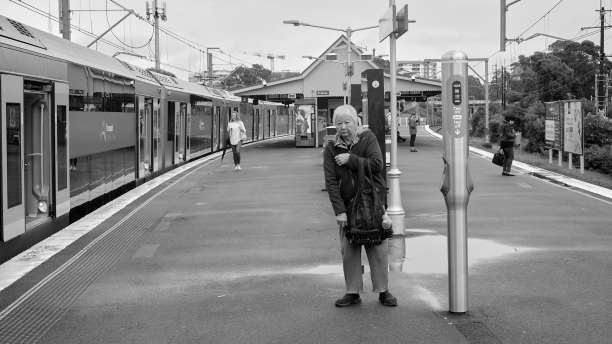
Photo of woman standing on Waitara platform

Since then, modernisation and more infrastructure upgrades have continued—electric trains, tap-on tickets and the like—allowing the station, and the whole suburban rail network, to remain relevant to travellers.

But some aspects of train travel have not changed since Stephenson introduced the world’s first public railway in 1825, the Stockton and Darlington Railway.

Above ground (suburban) stations remain essentially unchanged in their nature: long platforms surrounded by tracks and surmounted by a small or smallish cabin. Protection from the elements for travellers and security for the ticket seller are the main roles of the cabin. Irregular upgrades add facilities; perhaps a toilet, even a water fountain.

Upgrades are usually a reflection of the travellers’ desire for greater comfort and their expectations of a sophisticated rail network in our sophisticated society. Even at suburban stations. For those operating the rail network, upgrades are about keeping the network relevant and moving ever increasing numbers of travellers more quickly and safely.

But one aspect of today’s sophisticated rail networks has not changed: schedules. Trains still run on a schedule. So passengers wait for the next train. Sometimes they wait and wait and wait. But, at really sophisticated stations, at least they can see how long they will have to wait. And, of course, they can usually purchase from a machine a snack (unhealthy?) or sugary drink, such is our level of sophistication.
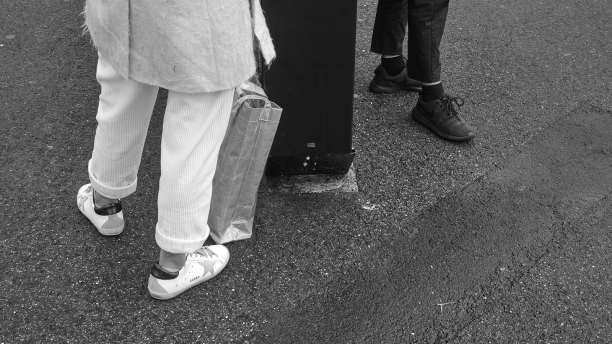
Photo of two sets of legs

Politicians now see advantage in fostering new infrastructure to relieve road congestion (more roads, naturally) and population pressures, issues for which they too often fail to acknowledge their culpability.

One day, perhaps, we as a society will value suburban railway stations as central to a sophisticated, fair and just society. We will limit roads, knowing that more roads are but short-term solutions to poor urban planning and inadequate (or no) population policy. 

Until then, visit a suburban railway station every so often and appreciate the foresight of those who, more than a century ago, established Waitara station.
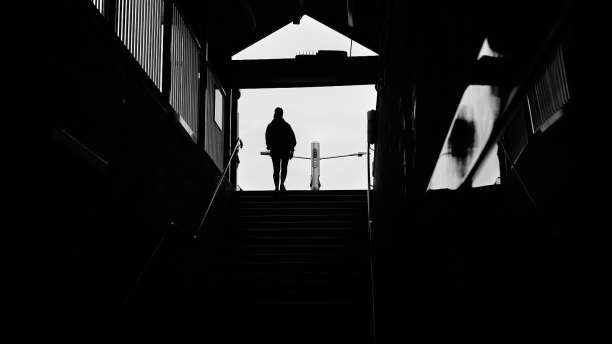

Silhouette of person coming from a swet of steps

Kaffeezimmer — 2018-09-25

Kaffeezimmer

Outside it is raining; not much, but enough to bring out the umbrellas. 

Photo of people walking in the rain carrying umbrellas

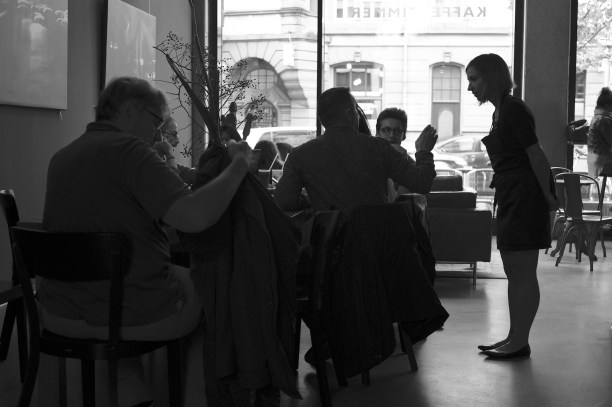
Inside the Kaffeezimmer the tables are occupied by coffee drinkers. Conversations fill the room. I do not understand them; they exist in another dimension.

A tattooed waitress takes orders, moving between tables and the serving area, delivering hot cups and cold pastries. Removing crumbed plates and cups stained with coffee remnants.

Photo of a waitress taking an orderIn front of me my camera awaits its next awakening, ever ready to capture passing photons.

My coffee arrives. Hot, strong, crema already dissipating like the passing of the rain outside.

Sip.

Two computers open; keyboards manipulating virtual words. Ones and zeros innately invisible, manifest through electrons and photons.

One couple in secret conversation; their heads together like conjoined twins.

Sip.

A regular flow of entries and exits. More ins than outs. Fewer empty chairs; fewer choices of where to sit, what to look at, though with smartphones who cares anyway?

Middle class coffee consumers I conclude. White Deutsch only. Others drink elsewhere, with their own familiars. Mixed ages, baby to me. Couples, groups, friends… and me.

Sip. Sip.

Punctuating human conversations are those mediated by smartphones. Thumbs engaging in violent conversation with virtual keyboards, strengthening invisible relationships. Maintaining friends and non-friends, all through the power of the electron.

I am (getting) old. Sip. My body is wearing out. Sip. Aches and pains more frequent. Cycling keeps me young, I like to think. Sip. Youngness is a state of mind, I am convinced. Sip. Sip.

Passers-by gaze through the windows, umbrellas raised against the diminishing rain as if water was harmful, an acid eating into our souls. What do they see in those transient glimpses of conviviality? Why do they look? What are they seeking? Are we, who imbibe in the dense, dark, brown liquid, like animals in a zoo, but with freedom to come and go as we please? To consume what we choose from a menu? Sip.

Others pass in ignorance, eyes closed to the goings on inside the poorly illuminated room. Why? Have they already passed judgement on us, we coffee drinkers, we conversationalists, we sharers of friendship, we shelterers from the rain? Do they find us unworthy or unnecessary even of attention? Irrelevant? Sip.

Perhaps it’s all about the coffee.

Sip. Sip.

Photo of a cup of coffee


Mungo — 2018-06-20

Mungo

Mungo. Lake Mungo. Mungo Man/Lady. Three terms, each with overlapping meaning, each with a different meaning. Each different but the same.

Fifty thousand years ago there was a lake at what is now Mungo, in western New South Wales. A large lake, covering around 200 square kilometres filed with wildfowl, fish, molluscs and other watery creatures. Around the lake wandered huge animals, megafauna, such as diprotodons, protemnodons and Genyornis. Trees and other vegetation completed the picture of a pristine, life-rich environment.

Over the centuries and millennia the climate changed, becoming drier. The lake became smaller and smaller, eventually disappearing altogether. As the lake dried so the vegetation became less, and then scarce, as it remains today. For reasons not fully agreed, the megafauna died out, rather quickly in evolutionary timeframes. Today’s smaller native animals eek out a survival where once there was plenty.

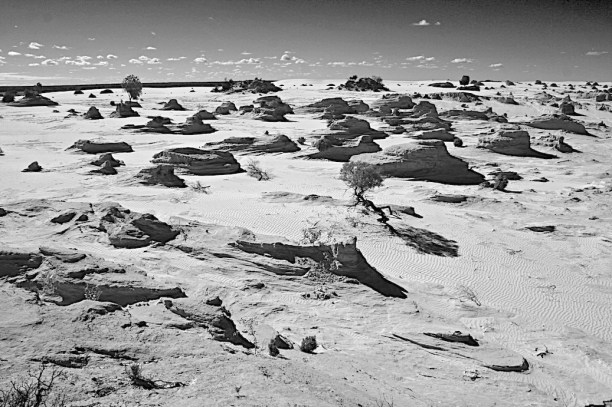
Visiting Mungo today one is challenged to see where once was water, challenged to imagine the once lushness surrounds, the thriving fauna and flora; the plethora of life. In their stead one is overwhelmed by the starkness and raw beauty of the place. 

View of the lunettes at Mungo

Vistas of flat, dry landscape with trees disturbing the flatness of the horizon greet the hungry eye. Huge sand dunes—the Walls of China—stretch for about 33km on the eastern side of the lake bed. These are constantly reformed and relocated by winds without barriers. Lunettes, irregular formations of soil eroded by wind and occasional rain, provide a fairy land for the imagination. 

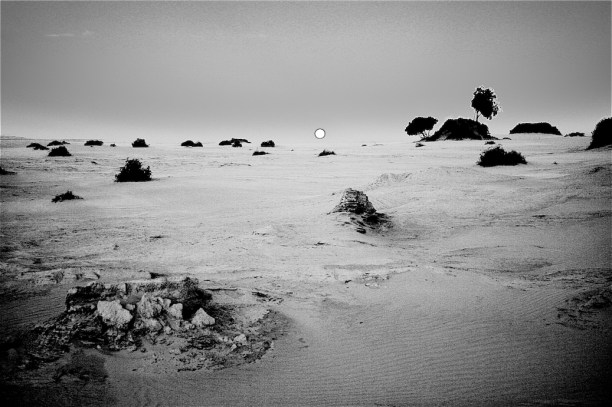
At night, as the moon rises from amongst the lunettes, the landscape is bathed in pale eerie light, like incomplete memories of precious moments past. Occasionally, lightening flashes over the distant horizon, a precursor to hoped for, but unlikely, rain.

Picture of moon rising over the lunettes at Mungo

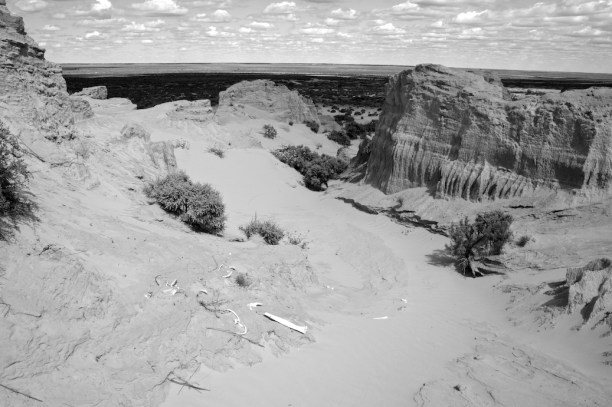
Wandering through the lunettes or around the vastness of the dry lake bed one comes upon the remnants of past life: long buried bones emerging from the soil. A small skull. Teeth; a jaw. Animals long dead like the long dead lake itself.

Picture of bones emerging from the soil at Mungo

Amongst these exposed remnants were found, in 1969, human bones, Mungo Lady. Two more sets of human remains were later found, including those of perhaps the world’s oldest known cremation. 

These people were from a culture that recognised death and maybe even the notion of a life after death. And they existed so long ago, at least 30 000 years in the past, perhaps up to 60 000 long years ago.

What changes the ghosts of these long buried peoples have seen and look down upon today. A landscape unrecognisable, a society without a sense of belonging, a peoples existing in splendid isolation from the elements, their food and the environment in which they live. Their descendants marginalised, wrapped in a long history, seeking acceptance, reconciliation and equality.

We live in the shadows of the Mungo people—or Universal Man, as Mungo had their contemporaries all across this wandering planet of ours, our Earth. We do not notice this shadow unless we still our minds and bodies and look around with eyes seeking the unseen, ears listening for the unheard and hands reaching for the touch of the untouched.

Mungo, lake and person; past, present and future co-existing and co-located. In time, we will all become like Mungo: a relic, bones in the sand, testaments to life long passed. What world will our ghosts look upon? What changes will they observe? What regrets will they hold? Will our bones become as sacred as those of Mungo? Unlikely, I think.

Meaning and cycle touring — 2018-02-16

Meaning and cycle touring

There’s a certain simplicity in cycle touring, a simplicity founded in routine. To get from A to B, perhaps via C, D, and E, one follows a pattern: arise, prepare for the day, ride, settle down at the end of the day. Repeat day after day after day after day until one finally arrives at B.

Simple routine. Profound meaning.

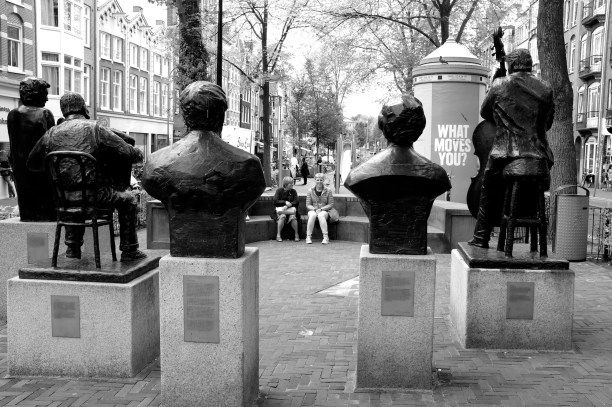
Bronze statue orchestra playing to a an audience of three women near a poster asking "What moves you?'

Meaning is construed by each of us according to our experiences, hopes, expectations. Different people attribute to the same act different meanings. Sometimes those meanings are similar, at other times they are quite different. But the meanings are never identical just as no two people are identical.

So cycle touring means different things to different people. It may mean escape (from other routines, from relationships, from the confines of urban life), adventure, self exploration and discovery, or simply the pleasure of being outside riding a bicycle, possibly in a new location or culture. It may be, at the one instant, all of these or none of them. Such is the vagary of meaning.

My reflection on cycle touring and its meaning is as a result of preparing a talk on my tour down the Rhine River, from Andermatt to Amsterdam. My mood is pensive, my reflections informed by a longing for escape to another fulfilling tour and the timelessness of retirement. Three episodes of mountain biking a week do not fill the gaps in my life, though they represent a routine. Checking email several times a day is not so much a routine as an expression of hope for interest, adventure, excitement, shortcomings in my life. Three meals a day become a bore, especially their preparation.

So my thoughts turn to a mobile life complemented by musings on the viability of living in a small space. With many fewer possessions. Too many of those I now have bind me to the past, both its highs and lows. Knowing this I remain unable—or is it unwilling?—to reduce the stockpile of things attesting to past life.

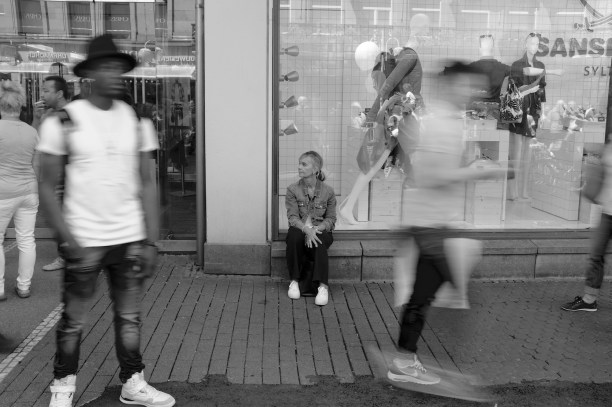
Woman sitting outside a fashion shop with people moving around her

Cycle touring requires small spaces—panniers, bar bags, back packs—and few possessions. There is no room in these small spaces for past life, other than those recorded in digital images and words. Space is required for those objects that maintain the routine of the tour: clothes, food, reading material (digital?), bicycle spares, digital devices and their accessories. Perhaps camping equipment, if essential to the tour.

Instead of ruminating on life’s past successes and failures, the touring cyclist ponders the next few kilometres or village, wondering what they will offer, how one will be affected by them. When thoughts do turn to the past those thoughts are of the life of the routine: past campsites, people met upon the trail, vistas, even mechanical matters. Experiences.

Experiences are the cornerstone of cycle touring, the building blocks of meaning, the creator of character. What the cycle tourist lacks in space is compensated for by an abundance of experiences, not all of which are pleasant, but all of which are meaningful.

To venture into the realm of cycle touring is to embark upon a quest for meaning, a quest mediated by routine. Don Quixote on a bicycle.

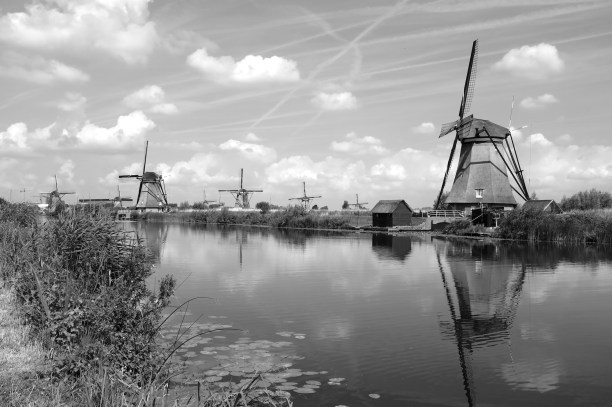
Windmills on the side of a canal